
In late August of 2008, at the “Sharpie 500″ Sprint Cup at Bristol Motor Speedway, the pre-race festivities included an official attempt at the world’s largest wave, with an estimated 168,000 people taking part.

Imagine you were there that evening, standing in front of the pits next to a man holding a green flag. The race is about to begin, and the tiny half-mile track is filled with the din of the sold-out crowd. You can barely hear the announcer over the PA system as he tells everyone about the planned wave. Then the starter points the green flag at the throng in front of him and sets it off.
As the multitude roars, you observe the human wave start off towards the first turn. You watch as masses of people jump up and sit quickly back down, section after section around the turn. You might wonder at some point whether they will keep it up, but as you watch you see the wave come sweeping out of turn four and head to the finish line.
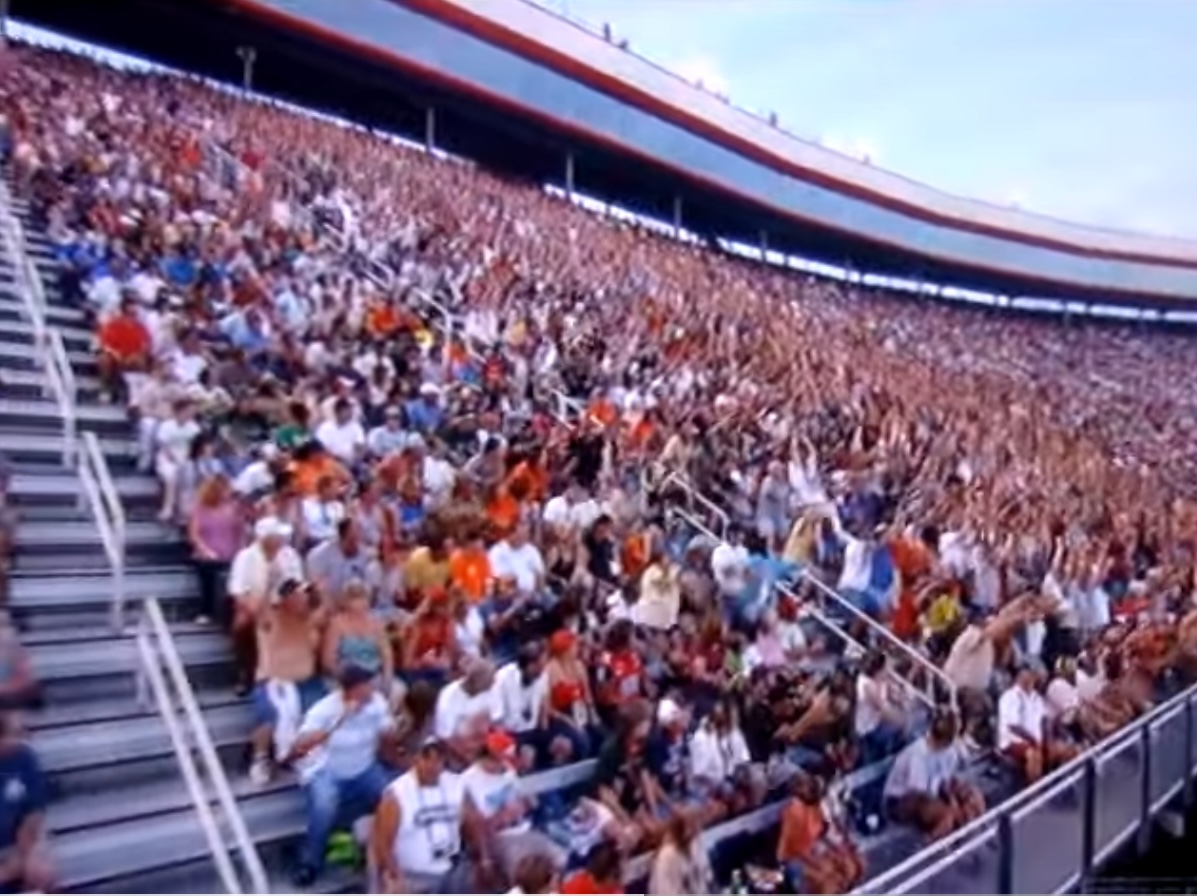
Now imagine that, as the wave sweeps down the home stretch and continues on for a second lap, your focus shifts to a single person in the stands in front of you. Maybe it’s a friend, or a celebrity you recognize; maybe it’s a particularly attractive stranger. In any case, focused on this particular person, you watch as they suddenly jump up and throw their arms in the air with a cheer and then quickly sit back down.
What happens next? Do you continue looking at this person – if it’s a friend do you smile and wave to them? Do you turn your focus back to watching the human wave swing around turns one and two?
More importantly, do you think about the perceptual shift you just experienced?
To understand what just happened, let’s consider an analogy from modern physics. According to quantum physics, all matter and radiation have both particle- and wave-like attributes. Any distinction between these two properties is simply due to how they are observed.
As demonstrated by the famous double-slit experiment, an electron will reveal either its particle or wave nature based on how it is perceived when it goes through either one or two slits. Simply stated, if only one slit is open an electron will act like a particle; if two slits are open it will behave like a wave.
A similar effect can be recognized in our scenario from the racetrack. As we saw, you can either watch a crowd doing the wave or you can watch an individual participating in that wave – you can’t see both at the same time. What you see is the result of a shift in how you perceive what’s in front of you.
A question at the heart of the schism in today’s politics concerns an either/or distinction between individualism and collectivism. Are we individuals who live and achieve things on our own, or are we members and products of a larger collective?
Recognizing the perceptual shift we experienced in that race track scenario offers us a way beyond that either/or conflict. It becomes clear that this conflict is a result of fragmentary perception, in which we only see the wave going around the track or we only see individuals jumping up and down. Each of these perceptions is incomplete on its own; the event only fully makes sense when we consider both facets equally.
A wave depends on individuals deciding to take part by standing and throwing their hands up in the air and then quickly sitting back down. But these individual actions are tied to the actions of the rest of the crowd. Individuals are only likely to take part if the people in the section before theirs are participating. And their decision to participate increases the likelihood that the people in the section after theirs will also take part.
Just as matter and radiation have both particle- and wave-like characteristics at the same time, any accomplishment by a group of people has both individual and collective qualities simultaneously. Any achievement an individual gains from a group endeavor is inextricably tied to the achievements of the other members of the group.
Americans have historically had a strong sense of individualism, but in the past such individualism was leavened with an awareness of a collective American spirit. Our national motto – “E pluribus unum” – proclaims “out of many, one.” Our Declaration of Independence concludes with the phrase “…we mutually pledge to each other our Lives, our Fortunes and our sacred Honor.” And at the signing of that document Benjamin Franklin famously said “We must all hang together, or assuredly we shall all hang separately.”
Today we have many who subscribe to an extreme form of individualism, which appears to have no appreciation of this collective spirit. In its place has been erected a paean to “liberty” in which individuals are free to do whatever they please with minimal regard to the effects of their actions on others and society.
And so we have individuals in business whose primary goal is maximizing their personal wealth with minimal regard to how their actions affect those who work for them, the shareholders and customers of their companies, or the communities of which they are ostensibly a part. We have politicians who are consumed with a desire for position and influence with minimal regard to their actual responsibilities to the voters they are supposed to represent and serve or to the public employees who carry out their policy mandates. And we have debates about issues like gun violence in which proclaimed individual rights eclipse any serious concern for the safety and well being of others in the community.
After decades of such extreme individualism we are dealing with its fruits, which include a growing economic disparity between the wealthy and everyone else, political gridlock and a steady decline in essential infrastructure and government services, and an inability to address critical issues like the steady stream of gun-related tragedies.
This is not sustainable. It’s time for us to renounce this extreme individualism and to regain an appreciation for the leavening effect of the collective American spirit. It’s also time we moved beyond the imaginary schism between the individual and the group.
Nothing is accomplished without individual action. But success is achieved on a collective level. The wave at that racetrack wouldn’t have happened unless individuals actively participated. But the final achievement – the wave – is a collective result.
If we want to find real success – as a person, as a business, or as a country – we need to get beyond the fantasy that our individual interests are somehow distinct from our collective well-being. As we learned at that racetrack, success only comes when we see our individual talents and accomplishments blended with others to create a larger wave of human achievement.
It’s time we learn to ride that wave into a successful future.

 Quantum Sense