Self-reliance

There’s a lot of talk these days about self-reliance. According to some, our lot in life – our success or failure – is all up to us. As GOP presidential candidate Herman Cain recently said:

“Don’t blame Wall Street, don’t blame the big banks, if you don’t have a job and you’re not rich, blame yourself. It is not someone’s fault if they succeeded, it is someone’s fault if they failed.”

According to psychologist and social scientist Dacher Keltner, Cain’s perception of self-reliance is common among the rich. As MSNBC’s Brian Alexander reports:

…rich people are more likely to think about themselves. “They think that economic success and political outcomes, and personal outcomes, have to do with individual behavior, a good work ethic,” said Keltner, a professor of psychology at the University of California, Berkeley.

Because the rich gloss over the ways family connections, money and education helped, they come to denigrate the role of government and vigorously oppose taxes to fund it.

This focus on self-reliance can be found among the non-rich as well:

…a strong allegiance to the American Dream can lead even regular folks to overestimate their own self-reliance in the same way as rich people.

As behavioral economist Mark Wilhelm of Indiana University-Purdue University Indianapolis pointed out, most people could quickly tell you how much they paid in taxes last year but few could put a dollar amount on how they benefited from government by, say, driving on interstate highways, taking drugs gleaned from federally funded medical research, or using inventions created by people educated in public schools.

However, focusing solely on individual self-reliance ignores the reality of our dual particle/wave nature. None of us exists in a vacuum; we are all dependent on people and forces outside of us. As Albert Einstein once said:

A hundred times every day I remind myself that my inner and outer life are based on the labors of others.

Our focus on self-reliance can even blind us about our selves. Ernest Becker, in his Pulitzer-winning book The Denial of Death, noted:

We don’t want to admit that we are fundamentally dishonest about reality, that we do not really control our lives. We don’t want to admit that we do not stand alone, that we always rely on something that transcends us, some system of ideas and powers in which we are embedded and which support us. This power is not always obvious. It need not be overtly a god or a stronger person, but it can be the power of an all-absorbing activity, a passion, a dedication to a game, a way of life, that like a comfortable web keeps a person buoyed up and ignorant of himself, of the fact that he does not rest on his own center.

This preoccupation with self-reliance flies in the face of today’s interconnected world. It also limits our potential. To understand this, think for a moment about computers. A computer by itself can make you productive in doing things like managing a business’s finances or writing a book. But a computer connected to the internet can do so much more.

The same applies to people. To succeed in life it’s not enough to simply be self-reliant; we need to be connected to the world around us as well.

Posted in dual nature, interconnected, quanta | Tagged , , , , , , , , , | Leave a comment

OccupyWallStreet and Failing Institutions

Jeff Jarvis has written about the OccupyWallStreet movement:

#OccupyWallStreet, to me, is about institutional failure. And so it is appropriate that #OccupyWallStreet itself is not run as an institution.

We don’t trust institutions anymore. Name a bank or financial institution you can trust today. That industry was built entirely on trust — we entrusted our money to their cloud — and they failed us. Government? The other day, I heard a cabinet member from a prior administration call Washington “paralyzed and poisonous” — and he’s an insider. Media? Pew released a study last week saying that three-quarters of Americans don’t believe journalists get their facts straight (which is their only job). Education? Built for a prior, institutional era. Religion? Various of its outlets are abusing children or espousing bigotry or encouraging violence. The #OccupyWallStreet troops are demonizing practically all of corporate America and with it, capitalism. What institutions are left? I can’t name one.

He goes on to say:

What’s happening is an attempt to define a new public, now that we can. Iceland, Tunisia, Egypt, and Libya are all countries being reimagined and remade: start-up nations. Hear Icelandic MP Birgitta Jonsdottir talk about building a new constitution, using Facebook, on the principles of “equality, transparency, accountability, and honesty” — liberté, égalité, fraternité, updated for the networked age.

In the end, this is why I wrote Public Parts, because we have the tools and thus the opportunity to rethink and reorganize our publics and decide what they stand for. The power and freedom that Gutenberg’s press brought to the early modern era, our networked tools now bring everyone in this, the early digital age. “They empower us. They grant us the ability to create, to connect, to organize, and to aggregate our knowledge…. They lower borders, even challenging our notion of nations.” That’s what the youth of these countries are doing.

I agree with the observation that many of our institutions are failing in important ways. However, I think this failure is symptomatic of larger changes happening in our world.  It’s not a matter of intent – the leaders of these institutions aren’t trying to be evil.  Rather it’s a reflection of the fact that those in charge are products of a different era and mindset, which is incapable of understanding and adapting to our changed world. As I have written before:

…many institutions are failing because they haven’t adapted to the ways our world has changed. One thing that’s striking about many of the big institutions finding themselves in hot water these days is that a big part of their problem appears rooted in a mistaken belief that they are able to tightly manage/control the information about problematic issues. Toyota had problems with car defects; it tried to hide them. The Church had problems with perverted priests; it tried to hide them. Goldman Sachs had problems with very risky investments and very shady dealings to get rid of them; it tried to hide them. Tiger Woods had a thing for cocktail waitresses; he tried to hide it.

In an earlier, less connected time, perhaps these things wouldn’t have become such big deals. Probably past experience in hiding problems had led the leaders of these institutions to try a similar approach in these cases.

However, they apparently didn’t realize that in today’s hyper-connected world it’s almost inevitable that bad things will come to light – whether it’s vehicle flaws, priests behaving badly, devious investment strategies, or adulterous affairs. And now when the news DOES come out, the impact is likely to be much greater than it might have been before the Internet and global communications – especially if it’s apparent there was a cover-up involved.

As I noted last year, the end result for all of these failing institutions will depend on their ability to adapt to our changed world:

I think this time is like any other in which great change has taken place. Some people and institutions will adapt to change and thrive; others will fail to adapt and fall by the wayside, deserted by their former supporters and clients.

Some may loudly protest the change and uncertainty of today’s world. They may even gain enough influence to hamper some institutions’ ability to adapt to these changes. But they can’t stop the change itself. In attempting to turn back the clock and to resurrect an illusory past they will be much like a bunch of Americans in the Panama Canal Zone back in 1964: all they are likely to accomplish is a quicker demise of the institutions they had hoped to preserve.

I’ve never been a believer in the so-called “Wisdom of the Market” as the term applied to Wall Street. But I do believe in the idea as it applies to transformational times and ideas. When the times are changing, the ones who understand and adapt to those changes will be the ones who thrive in what comes.

In the end we will be left with a combination of old institutions that adapted and new institutions that saw a better way and followed it. Everything else will just be history.

Posted in emergent, interconnected | Tagged , , , , , | Leave a comment

Failing Tests

There’s been much talk lately about problems with the No Child Left Behind law. So many states are falling behind on meeting some of its provisions that the Obama administration has announced it will issue waivers to free them from its shortcomings. But maybe the problem isn’t with the specifics of certain provisions of the law. Maybe the problem is with its whole approach: evaluating the quality of a student’s education by giving them a standardized test.

Cathy N. Davidson, who teaches at Duke University, believes that approach is out of place in today’s world. In a Washington Post opinion piece she notes that “When Frederick J. Kelly invented the multiple-choice test in 1914, he was addressing a national crisis.” That crisis was caused by an explosion in the number of secondary school students:

The ranks of students attending secondary school had swollen from 200,000 in 1890 to more than 1.5 millionas immigrants streamed onto American shores, and as new laws made two years of high school compulsory for everyone and not simply a desirable option for the college bound. World War I added to the problem, creating a teacher shortage with men fighting abroad and women working in factories at home.

According to Davidson, Kelly drew on the mechanical mindset of the time to propose a solution:

The country needed to process students quickly and efficiently. If Henry Ford could turn out Model Ts “for the great multitude,” surely there was an equivalent way, Kelly wrote in his dissertation at Kansas State Teachers College, to streamline schooling. What he came up with was the Kansas Silent Reading Test, sometimes called the “item-response” or “bubble” test.

Such tests have been with us ever since, from high school aptitude tests (like SATs) to end-of-course and/or exit exams used by many states to meet the requirements of No Child Left Behind. Unfortunately, as Davidson points out, these tests are ineffective:

In a decade of researching digital education, I have never heard an educator, parent or student say that the tests work well as teaching tools. Beyond the flaws of these rigid exams — which do not measure complex, connected, interactive skills — there is little room in the current curriculum or even in the current division of disciplines (reading, writing, math, natural sciences and social studies) for lessons about key questions that affect students’ daily lives.

Interestingly (to me anyway), there’s been a similar conundrum in the audit field. Auditing has traditionally focused on hard controls (things like procedures, segregation of duties, supervisory oversight, etc.). However many of the biggest business failures – like Enron, Tyco and the recent debacle on Wall St. – were rooted in soft controls (things like employee morale, ethics, philosophy, values, integrity, etc.).

What we’ve learned is that having great hard controls won’t matter if a company’s leaders and/or staff are not inclined to follow them. Author James Roth described a situation he encountered during the Savings & Loan crisis:

During the S&L crisis, I was working for a banking organization in Minneapolis, where a $3.5 billion S&L failure occurred. After the S&L was dissolved, our bank acquired six of the S&L’S branches. When we began the first audit of those branches, we expected to find their internal control systems riddled with holes.

We were surprised to find instead that those branches were beautifully controlled according to our audit tests. They had every policy, procedure, and checklist imaginable. A teller could not swipe $10 from her drawer without getting caught. In spite of the control activities, the president and founder was able to play games; and he, his daughter, and several members of the upper management team went to jail.

After that, I asked myself if I had been an internal auditor working at that organization and using our control activity-based audit program, would I have had the foggiest notion of what was happening? Not from my audit work. The only way you would ever find out something like that is if someone tipped you off. That sort of realization makes you feel really uncomfortable about your status as a professional evaluator of control.

As Roth noted seven years ago in talking about the Sarbanes-Oxley Act that was passed after the failures of major companies like Enron and Tyco:

Companies are spending enormous time, energy, and consulting fees documenting and testing detailed financial control activities to comply with Section 404 of the U.S. Sarbanes-Oxley Act of 2002. But if all this resource-intensive work had been performed at Enron, WorldCom, or Parmalat, would it have prevented what happened? For that matter, would it have prevented any of the recent financial reporting disasters? Such frauds are not caused by noncompliance with low-level accounting procedures. The root cause is always a breakdown in the control environment, usually the ethical climate and the behavior of executives. Testing of accounting procedures to the extent it is done today is not only expensive, but also–for the most part–misses the point.

Why have auditors traditionally focused on hard controls rather than soft when examining businesses? In large part because they’re much easier to measure and evaluate. Why do politicians and administrators favor standardized tests when evaluating schools? Most likely for the same reason.

It reminds me of an old joke:

A cop saw a blonde down on her knees under a streetlight. “Can I help you?” he asked.
Replied the blonde, “I dropped my diamond ring and I’m looking for it.”
Asked the cop “did you drop it right here?”
“No,” she responded, “I dropped it about a block away, but the light’s better here.”

Just being able to test for something doesn’t mean the results will be relevant.

If we really want to ensure that America’s children are being properly educated, it’s not enough to simply make them take standardized tests. As with auditing, we must make sure those tests aren’t missing the point.

Posted in complexity, uncertainty | Tagged , , , , | Leave a comment

Ten Years After

There’s been a lot of talk this week about how 9/11 has changed things. For example, the Huffington Post has introduced a section titled “9/11: A Decade After” in which, according to Arianna Huffington, they will explore “all the ways in which we’re different since that day.”  Also, PBS recently had a piece in which some of their reporters reflected on “the day that changed everything” and MSNBC had an article about how 9/11 had changed individual lives.

In many ways 9/11 has changed things on a personal level. Clearly, those who lost friends or loved ones on that day have experienced a profound change in their lives. In addition, members of the military and their families have made many sacrifices for our country since that day. For the rest of us, we’ve experienced changes like stricter security in many public gathering places and when traveling by air.

But in a fundamental way, 9/11 didn’t really change our country. As NPR quotes from a New Yorker article written by George Packer:

The attacks were supposed to have signaled one of the great transformations in the country’s history. But the decade that followed did not live up to expectations. In most of the ways that mattered, 9/11 changed nothing.

One change we have experienced as Americans has been a new, acute awareness of a change to the world that had been going on for some time.

Globalization and the inter-weaving of different parts of the world had been happening for years. Many of these changes had been creating stress and upheaval in other parts of the world, like countries in the former Soviet Union and the Middle East. But we Americans tended to feel removed from that turmoil, protected by oceans the way some communities feel safe behind gates.

We generally hadn’t noticed that change because it happened gradually over time.  It’s like the change from summer to fall: the weather changes gradually for weeks, but we don’t really notice it until one day we realize summer’s hot days have “suddenly” been replaced by the crisp days of fall.

In a similar way, 9/11 suddenly made us aware of how the world had changed and had become much more tightly interconnected. As Joel Achenbach noted in the Washington Post:

Blessed by geographic isolation from the rest of the world, Americans did not feel vulnerable on their home soil. Most terrorism events had happened in distant places such as Lebanon, Kenya, Tanzania, Yemen.

What 9/11 did was remove the illusion of American invulnerability; of safety provided by great distances.

So what are we to do with this hard-earned loss of illusion? Perhaps we should start by recognizing and coming to terms with the realities of our interconnected and interdependent world.

This is not a new idea; it was proposed by Robert Wright in a Slate article in November 2001. In writing about the post-9/11 world, Wright pointed to a “big idea” that would help us understand this world: interdependence.

The idea that modern history makes the peoples of the world increasingly interdependent goes back at least as far as Kant and includes such contemporary writers as Joseph Nye, Robert Keohane, and, lately, me.

He went on to suggest that Bin Laden was a reflection rather than a source of this change:

Is “interdependent” really the best way to describe our relationship with a cave-dwelling man who is bent on destroying our civilization? No, but Osama Bin Laden is just the foam on the ocean. He is the guy that history happened to cough up as a surface manifestation of underlying forces of growing interdependence. He is also a handy reminder that interdependence isn’t all sweetness and light.

Today, awareness of our global interdependence should be widely acknowledged. A rational analysis of today’s global economy, in which trouble in one place can upset the apple cart halfway around the world, makes clear how interconnected we all are.

Still, some people seem consumed with the notion that we can regain our old illusions. They devoutly pursue a faith in “Individualism” for both our country and its people. To them, any problems we face today are purely the fault of liberals and the government. All that’s needed is to let everyone do whatever they want to do – at least economically – and everything will be just fine.

But in the long run, any world view that passionately denies the reality of our interconnected, interdependent world is doomed to failure. Such passion can create a great deal of suffering for individuals, and it can cause our country to be passed by as other nations not subject to that passion successfully adapt to today’s world. But the world as it is – interconnected and interdependent, is here to stay.

Ten years after 9/11, it’s high time we accepted that fact and started dealing with it.

Posted in interconnected | Tagged , , , , | Leave a comment

Is It Moral to Cheer Bin Laden’s Death?

I’ve noticed some discussion on the web and in the media about the reaction to Bin Laden’s death, specifically whether it’s morally appropriate to cheer such an event. I think this is a very complex issue that evades a simple response of right or wrong.

Part of this has to do with people’s experiences; a young woman on the News Hour tonight mentioned a friend who said “He (OBL) was the man who stole my childhood.” Noting that most kids in college today were 9-12 years old on 9/11/2001, that event must have had a profound effect on how they experienced their childhood. Perhaps that was a factor in why so many young people cheered the news of his death.

Another issue concerns the perception of Bin Laden. I’ve seen comments about the morality of cheering a human being’s death, even if he’s a Really Bad Guy. But we must recognize that Bin Laden was more than just a human being.

In many ways we relate to the world and things in it symbolically; we don’t see a rose as just a rose, we see it as a symbol of other things that may be less concrete but are still very real for human experience: love, romance, beauty, etc. Our relationship to roses is influenced by our knowledge of this symbolic quality.

In this way, Bin Laden wasn’t just a human being; by his own actions and intentions he had come to be a potent symbol of evil, of the horrors that some humans willfully and perhaps joyfully commit against other human beings. I think it’s possible that some of the cheering we saw Sunday night may not have been a reflection of hatred against Bin Laden as a person, but rather reflected a sense of release – that sometimes evil CAN be fought and defeated. Would it be illogical to cheer such an occurrence? (While the term “evil” can be fraught with misuse and abuse, I think it’s appropriate in cases like 9/11.)

Finally there is the question of our own natures. While we may strive to be good and moral, the fact is we are much more complex than that. Our beliefs, our faith, are more complex than that. I think an interview of Monsignor Albacete, conducted as part of the Frontline episode “Faith and Doubt at Ground Zero,” does a great job in exploring that issue. As Monsignor Albacete says:

From the first moment I looked into that horror on Sept. 11, into that fireball, into that explosion of horror, I knew it. I knew it before anything was said about those who did it or why. I recognized an old companion. I recognized religion. Look, I am a priest for over 30 years. Religion is my life, it’s my vocation, it’s my existence. I’d give my life for it; I hope to have the courage. Therefore, I know it.

And I know, and recognized that day, that the same force, energy, sense, instinct, whatever, passion — because religion can be a passion — the same passion that motivates religious people to do great things is the same one that that day brought all that destruction. When they said that the people who did it did it in the name of God, I wasn’t the slightest bit surprised. It only confirmed what I knew. I recognized it.

I recognized this thirst, this demand for the absolute. Because if you don’t hang on to the unchanging, to the absolute, to that which cannot disappear, you might disappear. I recognized that this thirst for the never-ending, the permanent, the wonders of all things, this intolerance or fear of diversity, that which is different — these are characteristics of religion. And I knew that that force could take you to do great things. But I knew that there was no greater and more destructive force on the surface of this earth than the religious passion.

Posted in complexity, relativity | Tagged , , | Leave a comment

Dreams Can Come True

With yesterday’s events and discussions related to Martin Luther King Day, I took the opportunity to once again watch Dr. King’s “I Have A Dream” speech. Beyond his wonderful oratory, I was struck by how similar in some ways that time was to our own. Like now, the country at the time was deeply and bitterly divided. Like now, many expressed a fervent resistance to change. And like now, that resistance was occasionally laced with threats of violence.

But from the perspective provided by over 47 years, it’s clear that the change Dr. King dreamed of in 1963 has in many ways come to pass. As pundit Mark Shields related on the PBS NEWs Hour in discussing the tragic events in Tuscon:

MARK SHIELDS: There was one observation that was made this week I just have to pass on to you by a friend of mine, Allen Ginsberg, who is an historian up in Maine. And he said, this week, we saw a white, Catholic, Republican federal judge murdered on his way to greet a Democratic woman, member of Congress, who was his friend and was Jewish. Her life was saved initially by a 20-year-old Mexican-American college student, who saved her, and eventually by a Korean-American combat surgeon.

JIM LEHRER: Dr. Rhee.

MARK SHIELDS: Dr. Rhee, that’s right.

And then it was all eulogized and explained by our African-American president. And, in a tragic event, that’s a remarkable statement about the country.

Something like that could never have happened – or perhaps even been dreamed of – back in the mid-1960s.

Another event that might not have been dreamed of back in 1963 took place yesterday on the steps of the Lincoln Memorial, where a group of fourth-graders from Washington, D.C.’s Watkins Elementary School gathered to read Dr. King’s famous speech. Seeing boys and girls of different races gathered together to read snippets of the speech brought to mind something Dr. King said in his speech:

I have a dream that one day down in Alabama with its vicious racists, with its governor having his lips dripping with the words of interposition and nullification, one day right down in Alabama little black boys and black girls will be able to join hands with little white boys and white girls as sisters and brothers. I have a dream today.

The way yesterday’s event was presented – with many different children reading parts of it, rather than one person reading the whole thing – seemed to reflect a sensibility that we are all a part of a larger whole, united in our diversity. This is a viewpoint that is much more common today than it was back in 1963.

Ironically, yesterday’s event also reminded me of a recent event in the new (Republican) House of Representatives, in which different members took turns reading parts of the U.S. Constitution. While the people who came up with that event may not have intended it, the methodology of the event reflected an inclusiveness not unlike yesterday’s children’s event.

It’s always hard to say what the future holds. But in reflecting on how far we’ve come from Dr. King’s speech in 1963, it seems at least possible today to dream of a united America that will someday move beyond the fears and vitriol raised by our current era of change.

Posted in interconnected | Tagged , , , | Leave a comment

Government By The People

Modern technology has empowered us in many ways.

With a computer or smart phone I can (among other things) keep in touch with friends, share photos, check the weather, compare prices on just about anything, find out which products or vendors are good or bad, contribute to websites like Wikipedia, create and give or sell items, and express my thoughts on a blog.

Smart businesses have recognized this trend and tapped into it. Amazon.com lets you comment on any product they sell and even get a commission when you refer people to their site. eBay lets you set up your own virtual store. TV news and sportscasts create polls to gauge your opinion and offer opportunities to show off your photo of the latest news or weather event. Apple invites you to share playlists of your favorite tunes for their iTunes store. Everyone seems interested in what you want and what you think, and looks for ways to put you in the driver’s seat.

Everyone, that is, except for politicians.

When it comes to our government, politicians all too often seem more interested in doing what they want to do, in spite of what we voters think. And what politicians seem most interested in doing is catering to the wealthy and powerful who will reciprocate by helping them stay in office.

This is starting to piss people off.

We heard a lot in the last election about how angry Americans have become these days. The Tea Party got a lot of press about their anti-Democratic Party focus, but the anger really goes deeper.  Frank Rich recently suggested that the cause of Americans’ anger today is:

“…the realization that both parties are bought off by special interests who game the system and stack it against the rest of us.”

This is true. But I think that anger and frustration is deepened further by the context of our times. When many other parts of our personal lives have become more responsive to our thoughts and needs, why does our government still seem so unresponsive? And how can we make government as responsive as a successful online store like Amazon.com?

This isn’t just a matter of Washington politics and big issues like bailing out Wall Street or health care reform. It also applies to minor local things like getting a pot hole fixed. If I have problems with an order on Amazon.com, I can usually get it fixed in short order. Why does it take government so much longer?

There are a number of reasons for this, including a lack of imagination and accountability by many of the people in charge and a lack of resources to create new technology-based systems that would increase efficiency. Sadly, another key reason is that the current system actually IS responsive to those who really matter: the politicians and their financial masters. If the head of Goldman-Sachs is bothered by a pothole on his street, what do you think the odds are that it’ll get fixed in a hurry? For the rich and powerful, what’s the problem?

In spite of all this, we actually are seeing some tentative signs of technology being used to make government more responsive to the average citizen, including:

  • SeeClickFix offers citizens a way to notify their local government about an issue of concern (often something like a pothole). If you have an iPhone, there’s even an app for that;
  • Give a Minute offers Chicago residents the chance to tell the Powers That Be what would encourage them to walk, bike, or take public transportation more often; and
  • The US Initiative invites ideas for how we live together in cities.

While it’s promising to come across such initiatives, reviewing their websites has left me with doubts.

When I checked SeeClickFix for my neighborhood, I found a rather ragtag group of 9 items that citizens felt needed attention – some of which were reported 10 months ago and were still open. While some were general and less likely to be fully resolved (e.g., speeding cars on a heavily traveled road), some were seemingly simple items like potholes or sidewalk hazards. In addition, only two items were listed as “Fixed,” and those solutions were reported by other members of the public. I saw nothing that indicated our local government actually looked at and responded to the issues reported. So much for government responsiveness…

Meanwhile, the other two items listed above are projects supported by CEOs for Cities, an organization that appears to be focused on making cities more responsive to their residents.  According to its website, CEOs for Cities was created in 2001 and:

“CEOs for Cities is a civic lab of today’s urban leaders catalyzing a movement to advance the next generation of great American cities. CEOs for Cities works with its network partners to develop great cities that excel in the areas most critical to urban success: talent, connections, innovation and distinctiveness.”

I don’t know about you, but my eyes glazed over just reading that paragraph. The rest of the CEOs for Cities website reads the same way: lots of $10 words strung together in an academic way that is almost guaranteed to put you to sleep. Meanwhile, the Give a Minute and US Initiative websites seemed very spritely graphics-wise, but they weren’t very user-friendly. The Give a Minute site seemed particularly hard to navigate. Maybe that’s why neither site seemed to be overflowing with citizen input.

So how do we make governments as responsive as Amazon.com? Well…

  • Local governments could start using things like SeeClickFix and actually fixing (or at least responding to) the items their citizens report. Establishing a good track record would benefit both the local governments and their citizens.
  • The people behind CEOs for Cities and its projects could read “Made to Stick – Why Some Ideas Survive and Others Die” to learn how to make their points without sounding like a bunch of ivory tower eggheads. Being clear about what they’re doing and making citizens care about it might get more people involved.
  • As for the rest of us? We should start demanding that government get with the program and become part of the 21st century. With today’s technology, we expect free access to information and the opportunity to use it to improve our lives and our worlds. And we’ll become angry with those who try to restrict and control both the information and us.

It’s time we revived the principle of government of the people, by the people, and for the people. To the barricades!…er, keyboards!!!

Posted in emergent, interconnected | Tagged , , , | Leave a comment

The Trouble With Hurry

Every fall I set aside an evening to sit back and watch my DVD of the movie “The Trouble With Harry.” This movie, the only feature-length comedy created by Alfred Hitchcock, revolves around a body – Harry – found in the autumn woods in rural New England. It features an amusing array of characters and a mystery plot that keeps you guessing who might be responsible for Harry’s demise.

But that’s not why I enjoy the movie year after year. What I really like about it is the feel of the movie: autumn in rural New England. It really captures the placid beauty of the time and place, with the colorfully glowing trees, softly falling leaves, the crispness of the autumn sunlight, and the leisurely pace of the residents.

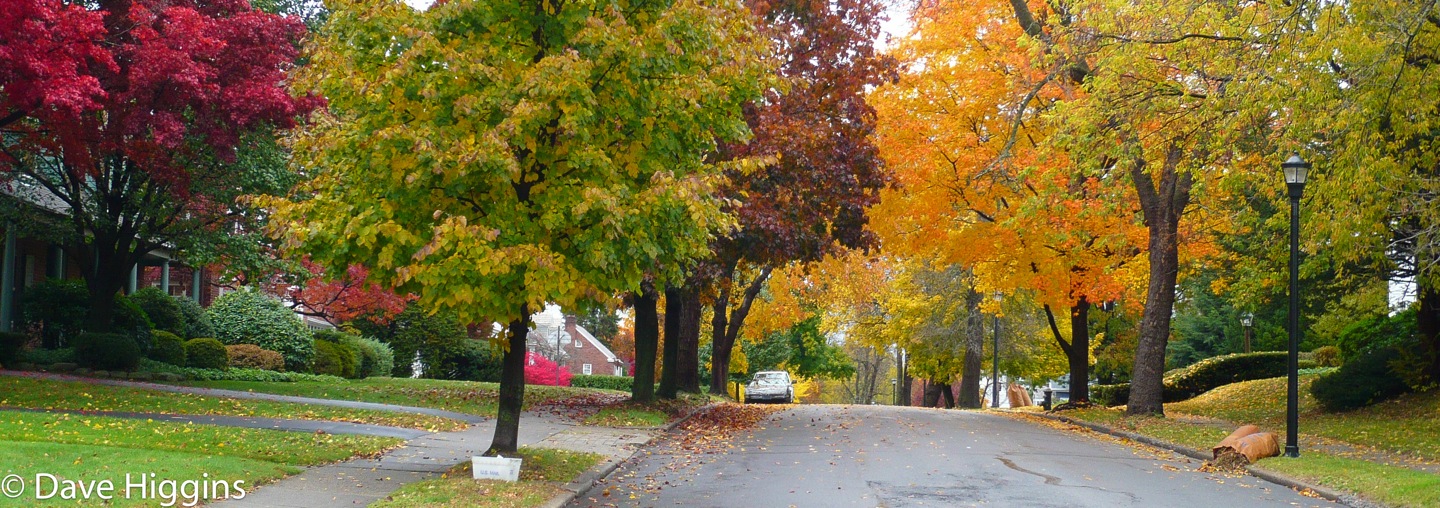
No wonder autumn is such a popular time of the year for leaf peepers. But you don’t have to travel far to see colorful foliage; many neighborhoods are graced with a multitude of trees decked out in vivid colors.

Residential street with fall leaves

Ironically, the ambiance of “The Trouble With Harry” is very different from our “normal” world today. Unlike the slow pace of rural New England residents, we seem to often be in a rush. We usually have so many things to do and so little time to do them that our focus becomes on what we have to get done – both at work and in our personal lives. Being productive becomes something of an obsession; with so much to do, there’s precious little time to waste.

Being surrounded by so many others who are also rushing about just amplifies things. The hyper energy of our co-workers/fellow shoppers/etc. raises our own energy and stress level. After a while we are so stressed out that we need a break from it all and have to get away to some place with a slower pace – perhaps like New England in the fall.

Unfortunately, if enough harried humans show up at one place at the same time (or if we try to cram too many activities into our schedules), we wind up bringing the hustle and bustle with us and the “break” winds up being as stressful as what we thought we were escaping from. The end result is we feel we need a vacation to recover from our vacation and the locals in vacation spots feel relieved when the “tourons” finally leave.

Stress and obsession with productivity also affects how we view people and things around us. It’s easy to become very resentful of anyone else who doesn’t seem to be “pulling his own weight” – as we feel we are.

At the same time, we can come to devalue any thing that doesn’t seem to add to our productivity. Pressed for time, we can come to dismiss as “pointless” the quiet appreciation of beauty, whether in a painting or a vivid display of colorful fall foliage. We may even come to resent trees and their falling leaves, and wish there weren’t any around to litter our yards.

But to me such yards and neighborhoods are missing something important…

Residential street with hardly any trees

…compared to neighborhoods with trees.

Neighborhood with trees in the fall

Maybe we need to stop and think for a minute about why our lives are so rushed and stressed out. Henry David Thoreau, in Walden, asked:

Why should we live with such hurry and waste of life? We are determined to be starved before we are hungry. Men say that a stitch in time saves nine, and so they take a thousand stitches today to save nine tomorrow.

Taking stock of our lives and slowing down is likely to alter our view of things. It might help us gain an appreciation of what’s important and what isn’t. It might also give us a better understanding of our world and the true value of things in it. An example of this alternative perspective was provided by Chuang-tse:

Hui-tse said to Chuang-tse, “I have a large tree which no carpenter can cut into lumber. Its branches and trunk are crooked and tough, covered with bumps and depressions. No builder would turn his head to look at it. Your teachings are the same – useless, without value. Therefore, no one pays attention to them.”

“As you know,” Chuang-tse replied, “a cat is very skilled at capturing its prey. Crouching low, it can leap in any direction, pursuing whatever it is after. But when its attention is focused on such things, it can be easily caught with a net. On the other hand, a huge yak is not easily caught or overcome. It stands like a stone, or a cloud in the sky. But for all its strength, it cannot catch a mouse.

You complain that your tree is not valuable as lumber. But you could make use of the shade it provides, rest under its sheltering branches, and stroll beneath it, admiring its character and appearance. Since it would not be endangered by an axe, what could threaten its existence? It is useless to you only because you want to make it into something else and do not use it in its proper way.”

Perhaps if we reflect on time and our lives, we will gain a awareness of what is truly valuable. We might gain a deeper sense of “productivity” – as something that enriches our souls rather than just our bank accounts and financial net worth. What should we really be working on, and toward?

Perhaps, with this greater awareness, we will come to revel in the beauty that surrounds us every day. And we’ll be willing to pay the price and do the work to allow that beauty to flourish around us. Whatever that price might be…

Lots of leaf bags
Posted in energy/flow | Tagged , , , , , , | 2 Comments

Start Making Sense

There’s a new etiquette issue these days that Ann Landers never had to address: what do you do when a friend or relative forwards some wacky right wing spam?

Wacky right wing spam seems to be a growing phenomena. Such emails can be identified by breathless proclamations, like “uncovering” some “totalitarian socialist” plot by President Obama, Democrats or everyday liberals to “sell your country down the river.” They sometimes feature an abundance of words in CAPS and citations of conservatives’ favorite news source, Fox News. Usually they also contain an admonition to SEND THIS TO EVERYONE YOU KNOW.

That’s where friends of wacky right wing spammers come in. Since we’re friends with – or related to – the spammers, we get these emails. And then we’re faced with the question of what to do about them.

For many of us, the choice has been to ignore and not say a word about them. We know the content is either misguided, misleading or totally false. But we don’t want to get into some big ideological argument that could damage our relationship with the spammer. Besides, it’s hard to reason with someone when they’re all rev’d up about some unreasonable claim. Who has the energy for that?

But lately I’ve come to believe that just ignoring right wing spam doesn’t accomplish anything except encourage more of it. I think there’s something to be said for letting the person know, in as gentle a way as possible, that what they’re spreading is out of touch with reality as you know it and that you disagree with them. Citations from Snopes, Truth or Fiction and FactCheck can be useful in pointing the conversation back towards reality.

In essence, what this does is redefine their sense of the “social norms” for such points of view, without getting into a big (and unwinnable) argument about who’s right and who’s wrong. I don’t think we should try or expect to change anyone’s mind by doing this. But maybe we can make them aware of the fact that their “movement” is not really as mainstream and popular with their friends as they might believe, and maybe they should think a little about the truth of what they’re spreading. Hopefully, we can come to disagree without being disagreeable.

It seems worth a shot, anyways…

(BTW, all of this would be true for left wing spammers as well; but everyone I discuss this with these days finds the right wing spam much more common.)

<><><><>A Follow-up<><><><>

Thomas Friedman has a column in the NY Times today makes a similar point in discussing the absurd conservative claim that the President’s recent state trip to Asia cost $200 million a day.  (He notes that the war in Afghanistan currently costs the US $190 million a day.) He closes by saying:

When widely followed public figures feel free to say anything, without any fact-checking, we have a problem. It becomes impossible for a democracy to think intelligently about big issues — deficit reduction, health care, taxes, energy/climate — let alone act on them. Facts, opinions and fabrications just blend together. But the carnival barkers that so dominate our public debate today are not going away — and neither is the Internet. All you can hope is that more people will do what Cooper did — so when the next crazy lie races around the world, people’s first instinct will be to doubt it, not repeat it.

Gee, it’s like he read my blog! 😉

Posted in energy/flow, quanta | Tagged , , , , , , , | Leave a comment

Is THIS the American Century?

If you read or watch the news these days, it’s hard to avoid the impression that the United States is a nation in decline. The economy is lousy, our military is over extended, our leaders – both in government and in the private sector – all too often seem to be only focused on their own wealth and power, and a portion of the American populace seems hellbent on preventing our government from taking any steps whatsoever to address our many problems.

On the face of it, we seem to be following in the footsteps of other great powers like Great Britain or the Soviet Union. Some have even suggested we’ve already become a banana republic. The world has changed and many of our leaders, either unwilling or unable to adapt and guide us through this change, appear eager to grab whatever they can while they still can.

But maybe, blinded by outmoded ways of understanding the world, we’re not seeing things as they really are. Maybe all the chaos and commotion we’re going through isn’t a sign of decline…maybe it’s a precursor to a potential rebirth.

This thought came to mind after reading David Brooks’ column The Crossroads Nation in today’s NY Times. Starting with the idea that creativity is a wellspring for economic growth, Brooks suggests:

…economic power in the 21st century is not going to look like economic power in the 20th century. The crucial fact about the new epoch is that creativity needs hubs. Information networks need junction points. The nation that can make itself the crossroads to the world will have tremendous economic and political power.

Brooks was apparently inspired in this view by an essay in Foreign Affairs by Anne-Marie Slaughter, now director of policy planning at the State Department. In “America’s Edge” Slaughter describes today’s interconnected world:

We live in a networked world. War is networked: the power of terrorists and the militaries that would defeat them depend on small, mobile groups of warriors connected to one another and to intelligence, communications, and support networks. Diplomacy is networked: managing international crises — from SARS to climate change — requires mobilizing international networks of public and private actors. Business is networked: every CEO advice manual published in the past decade has focused on the shift from the vertical world of hierarchy to the horizontal world of networks. Media are networked: online blogs and other forms of participatory media depend on contributions from readers to create a vast, networked conversation. Society is networked: the world of MySpace is creating a global world of “OurSpace,” linking hundreds of millions of individuals across continents. Even religion is networked: as the pastor Rick Warren has argued, “The only thing big enough to solve the problems of spiritual emptiness, selfish leadership, poverty, disease, and ignorance is the network of millions of churches all around the world.”

As Albert-Laszlo Barabasi observed in his book Linked, in such a world the key is to be a central hub of the network. A web site like Google will be much more important and influential than a tiny site like this blog. As Barabasi puts it, “popularity is attractive.” Those web sites/people/etc. with the most connections are likely to be the most successful.

Brooks suggests this creates an American advantage:

…the U.S. is well situated to be the crossroads nation. It is well situated to be the center of global networks and to nurture the right kinds of networks. Building that America means doing everything possible to thicken connections: finance research to attract scientists; improve infrastructure to ease travel; fix immigration to funnel talent; reform taxes to attract superstars; make study abroad a rite of passage for college students; take advantage of the millions of veterans who have served overseas.

However, I suspect some will be reluctant to join in the chorus of “It’s a small world after all.” As Robert Wright observed in an essay reflecting on our networked world: “Interdependence theory has a reputation on the right for being a namby-pamby doctrine for naive lefties.”

So Brooks may be right about America’s potential advantage in a networked world. But will his opinion have any influence on those of his conservative brethren who seem consumed by a rabid individualism that “refudiates” any suggestion that all of us – even those who may not “look American” – are in this together? And will their actions keep us from cashing in on this advantage?

The fate of America may hang in the balance…

Posted in interconnected, quanta | Tagged , , | Leave a comment

Not Housing, But Homes

What long-term health care facilities are like is something many of us care about. After all, our parents – or we ourselves – could wind up in one of them at some point. Plus, we all pay for them through our health insurance and taxes; we’d like to know we’re getting the best bang for our bucks.

That’s why I was intrigued by a recent New York Times article by Allison Arieff about the newly renovated Laguna Honda, a city-run health care facility in San Francisco. Laguna Honda is intended for those needing long-term rehabilitation or nursing home care who are unable to afford other alternatives. According to Arieff,

…the new Laguna Honda suggests an inspired way of thinking about not only institutionalized care but of what a truly effective health care facility might look, feel and act like.

Arieff focuses on a key architectural feature of the renovated facility: abundant natural light. That figures, as she generally writes about design and architecture. Besides, I’d certainly go along with the view that natural light enhances our sense of well-being.

But I was also intrigued by what a senior architect on the project had to say about the ultimate goal of the renovation:

“From day one, we did not want Laguna Honda to be about 1,200 beds but about 1,200 places,” says Sharon Woodworth, senior architect with Anshen/Stantec, who helped lead the charge to scale the number back to a more humane 780. “The intent was always to create a ‘home,’ not an institution. Even if the project had been 120 or just 60 beds we still would have sought to create a sense of place beyond the bed the individual slept in — a place that felt like home — in a community setting. The community setting is a key difference.”

The facility is designed to create those communities, in which residents are brought together:

Laguna Honda’s bedrooms, for example, are organized into “households” for 15 residents who all have their own room, and each of these households has its own dining and living room with residential-style bathrooms shared by one, two or three residents in private bedroom suites or semi-private, dorm-style bedrooms. Four households on each floor create a neighborhood of 60 residents. In the end, it’s less institution, and more of a mixed-use, walkable community within a building.

One of the things I find interesting here is that this new approach echoes that of another innovative project that was introduced 20 years ago on the other side of the country.

Back in 1990 New York City’s Times Square was faced with the intractable problem of homelessness: many people either couldn’t afford to find living space, or they had other problems (mental illness, AIDS or other diseases, or drug addiction) that prevented them from living in normal housing. At the same time, Times Square was plagued by the blight of decaying buildings.

At the time most people had no good solutions to these problems. But a visionary named Rosanne Haggerty saw an opportunity and created Common Ground,  an organization that would take an holistic approach to the problem of homelessness by integrating individuals into community settings.

The group’s first effort was to rehabilitate the rundown Times Square – a former grand hotel that had become a decrepit rooming house – and turn it into decent housing for the homeless. But the Times Square wasn’t just a restoration of an historic building. It was designed to create a workable and supportive community for its residents as well. As Common Ground notes:

Individualized support services are designed to help tenants maintain their housing, address health issues, and pursue education and employment. On-site assistance with physical and mental health issues and substance abuse is available to all tenants, six days a week.

Like all of the organization’s projects that followed it, the Times Square embodied three components described on Common Ground’s website:

  • Affordable Housing. We build and operate a range of housing options for homeless and low-income individuals – housing that is attractive, affordable, well managed, and linked to the services and support people need to rebuild their lives.
  • Outreach. We identify and house the most vulnerable: those who have been homeless the longest, have the most disabling conditions, and are least likely to access housing resources. These individuals typically spend years cycling between emergency shelters, hospitals, and jails.
  • Prevention. We strengthen communities and prevent homelessness by addressing the multiple factors that cause individuals and families to become homeless.

This innovative approach of combining building restorations with the creation of supportive communities for those in need has been very successful. As Common Ground notes:

Our ground-breaking Street to Home program reduced street homelessness by 87% in the 20-block Times Square neighborhood, and by 43% in the surrounding 230 blocks of West Midtown. Spearheading a citywide strategy, Common Ground is now responsible for securing homes for people living on the streets in all of Brooklyn, Queens, and midtown Manhattan.

But beyond successfully helping the homeless, Common Ground’s approach offers major savings in tax dollars:

Our housing costs approximately $36 per night to operate – significantly less than public expenditures: $54 for a city shelter bed, $74 for a state prison cell, $164 for a city jail cell, $467 for a psychiatric bed, $1,185 for a hospital bed.

Laguna Honda has just opened and patients and staff are in the process of moving in, so it’s too soon to say what its long-term effectiveness will be. But maybe, as Common Ground’s experience has shown, this new approach will demonstrate how we can provide both positive experiences for those in need as well as a savings in health care dollars.

As Arieff suggested – based on her own recent experience with a less than satisfactory health care facility:

For those who must either spend an extended period of time recovering from truly serious injury or set up permanent residence in a place like Laguna Honda, Anshen/Stantec’s new way of thinking about a hospital’s staff and its patients and their families is a shining example not only of what is possible but what should be required.

Posted in holism | Tagged , , , , , , | 1 Comment

Oh…nuts

There was a lot of commotion recently about some nutty pastor in Florida who announced he was going to burn Korans on the 9th anniversary of the 9/11 attacks. First he was…then he wasn’t…then he might after all…then finally he didn’t.

There were many reactions to this minister’s announcements. It was opposed by the White House, General Patraeus, and the Vatican, among others around the world. He also wasn’t too popular in his home town.  Meanwhile, Muslims in many places were vehemently opposed to his plans, while some right wing wackos thought they were swell.

But not many raised an important question that was asked by a commenter on a Washington Post blog:

This “church” has around 50 members. 50 whackjobs who are now front and center on the world stage with everyone from Hilary Clinton to Angelina Jolie commenting on their proposed lunacy. How did this happen? It’s so discouraging that an ignorant and intolerant few can cause so much trouble.  Posted by: calgrl75

This is an important question for the time we live in. After all, it was another small group of “whackjobs” that were behind the 9/11 attacks in the first place. It seems that a by-product from our hyper-connected world is that a tiny group can have an out-sized effect on the world we live in. Andy Warhol’s claim that in the future everyone would have 15 minutes of fame doesn’t seem to do this phenomena justice.

What’s going on here? Robert Wright has suggested that this phenomena is a reflection of our increasingly interlinked, interdependent world. Writing in November 2001, he observed:  “…more and more, even fairly small groups with intense grievances will have the power to disrupt the world…”

Michael Gerson also noted our interlinked world when he said:

It is a horrifying wonder of the Internet age that a failed, half-crazed Florida pastor with a Facebook account can cause checkpoints to be thrown up on major roads in New Delhi, provoke violent demonstrations in Logar province south of Kabul, and be rewarded with the attention of America’s four-star commander in Afghanistan and the president of the United States.

That such tiny, nutty groups can have profound impacts on our world appears to reflect a kind of butterfly effect on steroids, in which minor actions in one place can unexpectedly set off major storms someplace else in the world.

Our natural instinct in dealing with these cases is to try to control them; we want to silence them, arrest them, even – in the case of al Qaeda – bomb them back to the Stone Age. However, such actions are often as likely to inflame the situation as anything else, making the wackos victims or even martyrs. In addition, by reacting to their actions, we inadvertently give these nut cases a form of control over our behavior. Rather than acting on the basis of our beliefs and values, we wind up reacting to theirs.

But if we can’t control them, what can we do?

We might start by considering a suggestion made by Margaret Wheatley in her book Leadership and the New Science: “What if we stopped looking for control and began, in earnest, the search for order?”

People have a variety of ideas about where that order may be.

Robert Wright suggested in 2001 that these nut cases would push nations to become even more interdependent:  “…more and more, it will be in the interest of nations to perceive and address simmering discontents, not just the discontents of Muslims, even if these discontents are the most pressing right now.”

Geneva Olelhoser has suggested that letting people like Terry Jones be heard can produce public benefits. Referring to Jones’ provocations, she notes:

Gatherings of clergy across all faiths took place. And those conversations got attention they’d never have gotten without the crisis. People have been awakened to prejudices and fears within their own communities, and to the global impact that these seemingly local occurrences can have.

If you think about it, this is pretty much the way we move forward as individuals: crises strike, they seem impossible to understand or accept, yet eventually we grow from them. The new media ecology makes it much more apparent (compared to the old top-down, “only what’s appropriate” method) that we humans tend to behave in unruly and undignified ways. But it also makes it much more likely that we will see the full range of opinion among our fellow human beings, and that we can all learn something together.

Alan Wolfe also suggested that giving extremists some space could be the best defense against extremism:

Publicity may be what extremists crave but it is also the best defense against extremism. No society can rid itself of those who burn with hatred. A wise society will give them the space to burn themselves out. When the ashes cool, we will recognize that although Jones thought he was using the media and commanding the attention of the powerful, they were at the same time using him.

This isn’t to say a forceful response is never called for. Certainly al Qaeda’s terrorism had to be dealt with. But it’s important to understand what the ultimate goal in such a response is.

Lawrence Wright , author of the excellent book on al Qaeda “The Looming Tower,” has argued that Osama bin Laden’s ultimate goal in his terror attacks was to draw the United States into a ground war in Afghanistan. Wright notes that bin Laden felt once that happened, the U.S. would be worn down in a lengthy war of attrition, just as the Soviet Union had been previously. When that plan blew up in his face with the routing of his forces by the Americans, bin Laden and al Qaeda were “repudiated throughout the world.” According to Wright, the U.S. had won its war against al Qaeda. But the American invasion of Iraq and that war’s subsequent chaos had “…given them (al Qaeda) new life.”

As Wheatley notes, the success of a society – like any other organization – in dealing with chaotic influences depends on whether its leaders are up to the task before them:

Anytime we see systems in apparent chaos, our training urges us to interfere, to stabilize and shore things up. But if we can trust the workings of chaos, we will see that the dominant shape of our organizations can be maintained if we retain clarity about the purpose and direction of the organization. If we succeed in maintaining focus, rather than hands-on control, we also create the flexibility and responsiveness that every organization craves. What leaders are called upon to do in a chaotic world is to shape their organizations through concepts, not through elaborate rules or structures.

This assumes that the leaders’ primary focus is on the well-being of their society in the first place. If they instead are consumed by a lust for power and control, or are devoid of firm beliefs rooted in reality rather than ideological delusion, then all bets are off.

In that case, the nut cases will take over the asylum.

Posted in chaos, interconnected | Tagged , | Leave a comment

Who’s the brains of this outfit? Maybe all of us

Robert Wright has an interesting piece in the NY Times titled “Building One Big Brain.” In response to concerns that modern technology is affecting the way we think, he has a suggestion:

But maybe the terms of the debate — good for us or bad for us? — are a sign that we’re missing the point. Maybe the essential thing about technological evolution is that it’s not about us. Maybe it’s about something bigger than us — maybe something big and wonderful, maybe something big and spooky, but in any event something really, really big.

He goes on to propose that

…technology is weaving humans into electronic webs that resemble big brains — corporations, online hobby groups, far-flung N.G.O.s. And I personally don’t think it’s outlandish to talk about us being, increasingly, neurons in a giant superorganism; certainly an observer from outer space, watching the emergence of the Internet, could be excused for looking at us that way.

While this may feel to us like a new phenomena, Wright notes that it’s happened before:

If it’s any consolation, we’re not the first humans to go cellular. The telephone (and for that matter the postal system before it) let people increase the number of other brains they linked up with. People spent less time with their few inherited affiliations — kin and neighbors — and more time with affiliations that reflected vocational or avocational choices.

This earlier case, Wright observes, had a major effect on Americans’ social behavior:

In the 1950 sociology classic “The Lonely Crowd,” David Riesman and two colleagues argued that the “inner-directed” American, guided by values shared with a small and stable group of kin and friends, was giving way to an “other-directed” American. Other-directed people had more social contacts, and shallower contacts, and they had more malleable values — a flexibility that let them network with more kinds of people.

In other words, Riesman, like Carr, noted a loss of coherence within the individual. He saw a loss of normative coherence — a weakening of our internal moral gyroscope — and Carr sees a loss of cognitive coherence. But in both cases this fragmenting at the individual level translates, however ironically, into broader and more intricate cohesion at the social level — cohesion of an increasingly organic sort. We’ve been building bigger social brains for some time.

The phenomena of “bigger social brains” stands as an interesting counterpoint to the fervent passion for individualism expressed today by many in politics and the media. Perhaps in some way these passionate individualists are sensing this emerging change and, frightened by the prospect, are fighting it with all they’ve got. Perhaps this is partly at the root of the fierce anger we see expressed at Tea Party gatherings and the like.

Perhaps. But if that is the case, it seems pretty clear their efforts are doomed unless they roll back technology to a time before the internet and television…and probably the telephone.

If change is being created by technology, then the only way to prevent it would be to get rid of that technology. But that’s not going to happen. Advances in technology often give new power to those who have that technology. People tend to not give up such power, especially if they see themselves engaged in a mortal fight for the “good old ways” over what they perceive as “evil new changes.” Sooner or later they’ll decide to keep the power and adapt to the change.

In any event, I think this perceived tension between individualism and the collectivism inherent in “social brains” is another reflection of an outmoded way of thinking. Sooner or later we will come to recognize that the wave/particle duality applies to humans as well as elementary particles: we are always and simultaneously both individuals and members of collective groups.

Now if we could just wrap our brains around that – both individually and socially.

Posted in dual nature, emergent, interconnected | Tagged , , , | Leave a comment