A Whole Earth Approach to Economic Growth

Happy Earth Day!

Actually, I suspect this isn’t such a happy day in some quarters. It is taken as a given by some businessmen, politicians and pundits that environmental concerns exist in a zero-sum relationship with economic growth. Their thinking appears to be that anything that will be good for the environment will be bad for business.

But that is not necessarily so. New York Times columnist Thomas Friedman recently had a column about the novel approach Costa Rica has taken in balancing economic and environmental concerns. He notes:

More than any nation I’ve ever visited, Costa Rica is insisting that economic growth and environmentalism work together. It has created a holistic strategy to think about growth, one that demands that everything gets counted. So if a chemical factory sells tons of fertilizer but pollutes a river — or a farm sells bananas but destroys a carbon-absorbing and species-preserving forest — this is not honest growth. You have to pay for using nature. It is called “payment for environmental services” — nobody gets to treat climate, water, coral, fish and forests as free anymore.

Friedman observes that much of Costa Rica’s economy is based on tourism and agriculture, so preserving its environment is integral to its economic health. So in the 90s they addressed this issue organizationally:

“In Costa Rica, the minister of environment sets the policy for energy, mines, water and natural resources,” explained Carlos M. Rodríguez, who served in that post from 2002 to 2006. In most countries, he noted, “ministers of environment are marginalized.” They are viewed as people who try to lock things away, not as people who create value. Their job is to fight energy ministers who just want to drill for cheap oil.

But when Costa Rica put one minister in charge of energy and environment, “it created a very different way of thinking about how to solve problems,” said Rodríguez, now a regional vice president for Conservation International. “The environment sector was able to influence the energy choices by saying: ‘Look, if you want cheap energy, the cheapest energy in the long-run is renewable energy. So let’s not think just about the next six months; let’s think out 25 years.’ ”

Beyond that, Friedman reports that the Costa Ricans factor in the value of a healthy environment for the long-term health of local businesses, and so have a carbon tax that helps support communities that protect the forests around them.

As we celebrate another Earth Day, we might consider the benefits of taking an holistic approach to dealing with economic growth and the environment.
Posted in holism | Tagged , | Leave a comment

A Mystery of Time

Put your hand on a hot stove for a minute, and it seems like an hour. Sit with a pretty girl for an hour, and it seems like a minute. That’s relativity. —Albert Einstein

Some people seem to have a big problem with the idea of relativity. With all the uncertainties confronting us, they want to believe that at least some things in life are solid and certain.

Take time. It seems so precise: the difference between “the thrill of victory and the agony of defeat” can sometimes be measured in thousandths of a second. It seems so predictable: when something’s going well, we say it’s “running like clockwork.” It gives us a sense of control: as long as we can schedule our activities and stick with that schedule, we feel we’re on top of things.

For some of us, the last thing we want to hear about is time speeding up or slowing down, and being relative to the position of the observer. It all sounds so elastic and ad hoc – like driving on a highway made of taffy that shifts unpredictably, stretching here and shrinking there.

Besides, who can even understand what the Theory of Relativity is all about anyway? It’s probably based on complex mathematics that most of us couldn’t hope to understand. It would be nice if someone could explain it in plain English, preferably using only words of four letters or less. Or maybe they could create a helpful video that illustrated the concept.

Anyway, what does relativity have to do with the way we experience time in our daily lives?

Quite a bit, actually. First of all, there’s the extremely subtle but real way it affects us. For example, if we’re flying in a jet we may not realize that time is slowing slightly for us, compared to people down on the ground. But precise chronometers could verify that was the case. But beyond such esoterica, as Einstein demonstrated in his example involving a hot stove and a pretty girl, our sense of time in the world around us does vary.

This came to mind recently when I watched the James Bond movie, “A Quantum of Solace,” on DVD. While I haven’t really followed the Bond movies since Sean Connery stopped making them, I’d heard intriguing things about Daniel Craig’s version of Bond and decided to check it out. (Plus it had “quantum” in the title, which always grabs my attention.)

The movie was entertaining, although I’m still partial to Ronin for spy action in a movie. But what threw me for a loop was something in the “special features” part of the blu-ray DVD. One of the features dealt with various locations where parts of the film were shot. It turned out several scenes were filmed in Panama. One, an extravagant party hosted by the film’s bad guy, was filmed in the ruins of a place that used to be called the Union Club. Included in the feature were pictures of the building as they found it, as well as clips from the movie in which it was lit and decorated.

I was really shocked to see what had happened to the place. When I lived in Panama back in the 60’s, it was a very fancy establishment: the Union Club was the place to be amongst Panama’s upper class. I remember our family dining there once, presumably as guests of one of my dad’s business associates. It was a beautiful building, with a fantastic patio view across the bay to the rest of Panama City. Seeing it as just another ruined building, with a view across the bay to a forest of skyscrapers that also didn’t exist when I lived there, gave me a jarring sense of how much time had past.

One of the curious things about time is how our perception of it can differ, depending on our presence to its passage. For Panamanians who’d lived in the vicinity of the old club since the 1960’s and who had watched the towers rise across the bay, the gradual day-to-day changes were most likely unremarkable. They probably didn’t give them a second thought. But for someone like me who had been away for a long time, the sudden shift from previous memories to current facts would be jarring.

However, there is a way those Panamanian locals might also experience that jarring sense of time past. If they were to come across old photographs from the 1960’s that they hadn’t seen in a long time, they would probably be amazed to see how different things were back then. They might comment on how beautiful the old Union Club used to be, and how the land across the bay used to be just trees, fields and a small airport. If they were personally in some of the old photos, they might also comment on how much they had changed themselves. In any event, they would also have the distinct sense of time passing, as the fact of the present confronted the memories of the past.

Another curious aspect of such “time shifts” relates to our sense of space. In the mid-1970’s I visited the neighborhood in New Jersey in which I had lived during the 1950’s. I had memories of long walks to and from school back then, and remembered our church was somewhere in the general vicinity. But when I visited almost 20 years later, I was amazed to see how close together everything was. It wasn’t nearly as spread out as I’d recalled.

There is still another peculiarity relating to time: how things are in the present tends to overwhelm our sense of how they were in the past or how they might be in the future. For those of us who live in upstate New York, in January it feels like it has always been wintry. But by the time July comes around, summer is our norm and wintry weather feels like eons ago. In both cases, the present is our only reality and times that differ with it feel like fantasies. The only things that make other times feel real are photographs taken from those times.

We’ve all had these experiences, whether in seeing an old friend’s children for the first time in five years, seeing old pictures of ourselves, going back to someplace we hadn’t seen since our childhood, or even spending some boring hours at work or in class. Our sense of time has a strange elasticity to it, which is only visible when we are confronted with an alternative perspective – like memories or photographs.

When we think about it, our varying sense of time seems rather odd and mysterious. Why do we sense time this way?

Perhaps we can get a clue from relativity. Our sense of time seems to be a matter of perspectives. If we have only one perspective – our memories or the way things are around us right now – we have one sense of time. But when we’re confronted with an alternative perspective – photos from other times or images that conflict with our memories – we have a very different sense of time’s passage.

It is understandable that we might be uncomfortable with relativity; it is only human to want a degree of certainty and solidity in our lives. But if our response to relativity in life is to shut out all alternative perspectives, we are basically choosing a life of illusion. It would be like my choosing to believe the Union Club still exists in all its former glory.

The memories of that time and place are nice, but they have nothing to do with current reality.

Posted in relativity | Tagged , , | Leave a comment

How the Internet Got Its Rules

The New York Times had an article recently, “How the Internet Got Its Rules,” which offered an intriguing glimpse of the beginning of a phenomena that is an integral part of life today. The article was written by Stephen Crocker, one of the people involved with creating those rules forty years ago in 1969.

One thing that’s striking is how the way the underlying rules for Internet programming were developed is reflected in the very nature of the Internet. As the group working on this matter proceeded, they were concerned about not “sounding presumptuous.” As a result, the process for making rules was open to all; bulletins on what was being discussed and decided were labeled “Requests for Comments,” or R.F.C.s. Crocker notes:

The early R.F.C.’s ranged from grand visions to mundane details, although the latter quickly became the most common. Less important than the content of those first documents was that they were available free of charge and anyone could write one. Instead of authority-based decision-making, we relied on a process we called “rough consensus and running code.” Everyone was welcome to propose ideas, and if enough people liked it and used it, the design became a standard.

Maybe it’s just me, but I’m sensing a bit of a “60’s vibe” in this paragraph. “Power to the people” indeed…

Anyway, the rules for the Internet were apparently an early form of open standards, which are integral to open source software today. This openness was key to the rapid development of the Internet and the World Wide Web:

This was the ultimate in openness in technical design and that culture of open processes was essential in enabling the Internet to grow and evolve as spectacularly as it has. In fact, we probably wouldn’t have the Web without it. When CERN physicists wanted to publish a lot of information in a way that people could easily get to it and add to it, they simply built and tested their ideas. Because of the groundwork we’d laid in the R.F.C.’s, they did not have to ask permission, or make any changes to the core operations of the Internet. Others soon copied them — hundreds of thousands of computer users, then hundreds of millions, creating and sharing content and technology. That’s the Web.

Put another way, we always tried to design each new protocol to be both useful in its own right and a building block available to others. We did not think of protocols as finished products, and we deliberately exposed the internal architecture to make it easy for others to gain a foothold. This was the antithesis of the attitude of the old telephone networks, which actively discouraged any additions or uses they had not sanctioned.

The way the rules for the Internet were encouraged to emerge through open collaboration is reflected in the emergent nature of the Internet itself.  Recognizing the power of this approach, Crocker has a suggestion regarding the issues we face today:

As we rebuild our economy, I do hope we keep in mind the value of openness, especially in industries that have rarely had it. Whether it’s in health care reform or energy innovation, the largest payoffs will come not from what the stimulus package pays for directly, but from the huge vistas we open up for others to explore.

Posted in emergent | Tagged , , | Leave a comment

An Illuminating Paradox

One time, while driving on an interstate highway when the weather was gray and misty, I noticed a curious paradox.

Although it was only sprinkling occasionally, nearly every car had its headlights on, complying with an obscure New York Sate law requiring headlight use when it rains. However, nearly every car was also going 65-75 miles per hour. This was certainly not in compliance with the well-known and publicized 55 miles per hour speed limit in effect at the time. It also didn’t make sense. Why would people obey a law they were unlikely to get ticketed or punished for breaking, while at the same time they disobeyed a law that they could easily get ticketed for, with substantial costs in fines and higher insurance?

This question stuck with me for a long time. While the behavior I witnessed did not seem logical, I was inclined to believe there had to be some reasonable explanation for it. After all, I was doing the same thing most of the other drivers on the road were doing. But beyond that, I sensed this observation might provide a key to getting people to be better drivers. This was particularly relevant to me at the time, as I was on my way to a traffic safety conference when I observed this paradox.

Around this time, I was reading M. Mitchell Waldrop’s book “Complexity.” While I was vaguely familiar with the concept of entropy, in which things are seen to be perpetually running down, I was totally unfamiliar with the new science of complexity, in which things are seen to be perpetually evolving into ever more complex and sophisticated ways of being.

And yet, while I had never heard of complexity, I recognized many examples of the phenomena it focused on. The cars we drive today are much more complex than even those I had admired in the 1960’s. Likewise, the economy we work in that enables us to produce and purchase those cars has also grown in complexity from that of the seemingly straightforward days of the 60’s; that economy in turn was much more complex than that of say, 100 years ago.

Perhaps, I thought, the paradoxical behavior I had observed on the highway was somehow a reflection of this tendency to evolve to increasingly more complex patterns of behavior. One of the qualities that Waldrop discussed was the “bottom up” nature of self organizing systems. Increasing complexity comes about because that is what the users of a given system want; it is not imposed from on high somewhere. Cars today are increasingly complex largely because we expect more and more from them.

This seems to be a natural function of the way we are. The more something like a car can provide us, the more we tend to want. Even if our present car is reliable, luxurious and sporty in its performance, after some time has passed we are likely to be drawn to a newer car that is better designed, more luxurious and sportier. And to provide us with such qualities in a car, manufacturers have to continually strive to use more refined and complex technology to improve on their product.

I felt this “bottom up” quality was important in understanding the motorists’ behavior I had observed. Clearly, the authoritative power of the State, conveyed both through the raw power of the police and the cajoling power of slogans like “55 Saves Lives” did not seem to be greatly altering their behavior. Something within each motorist seemed to be propelling them forward in the behavior they were pursuing. But what? And how?

Some time later I stumbled upon what is arguably one of the most revolutionary concepts in modern science. This is the dual, wave/particle nature of matter. I vaguely remembered something from the few weeks’ of high school physics I’d had about the dual nature of light, and how it behaved as both a particle and a wave. But I had always assumed, as most people do, that some things were particles while other things were waves. In a foggy kind of logic, I had presumed that tangible things like a table or a chair were made up of particles, while forms of energy like light or sound were composed of waves. However, modern science has discovered that, at it most basic level, everything is both particles and waves simultaneously.

At first I found this concept hard to understand. But with more reading and thinking, I gradually realized that the world around us is full of examples of this dualism. The catch is that at any one time you can only perceive something as either a particle or a wave. For example, you can see the ocean’s wave quality in the way it rhythmically crashes on the shore. Take a drop of sea water and put it under a strong enough microscope and you would see the particles that water is made up of. But you cannot see the particle and the wave nature of the ocean at the same time; you have to adjust your focus to perceive either one or the other.

The same is true of a crowd creating a “wave” in a stadium. You can either focus on the movement of the wave or you can focus on some individuals participating in it; you cannot focus on both at the same time.

With this new awareness, I realized what had been happening on that highway. Viewed from the individual, particle perspective, the behavior of those motorists did not make sense. They were obeying a minor law while flagrantly disobeying a much more important one. This did not seem to be in their own, individual/particle interests. But viewed from a group/wave perspective, there suddenly appeared a logic to their seemingly inconsistent behavior. In terms of both the minor and the more important law, their behaviors reflected those of the other motorists they observed on the highway.

If I see many other drivers turning on their headlights because it is raining, I will feel an inclination to do the same. If I see them going ten miles per hour over the speed limit, I will feel an inclination to do that as well. In both cases, the behavior reflects the “bottom up” quality complexity science focuses on. The drivers themselves create the norms for their behavior. While the State may establish a context for this behavior, through headlight laws or speed limits, the actual behavior has an ad hoc quality to it.

The reason often given by traffic safety authorities for drivers mirroring others’ behavior is because they (the drivers) feel there is less possibility in a group of being caught. However this reflects only the self interest, particle perspective, which leads us back to the original paradox. It might explain the speeding, but what about the minimally enforced headlight law? Why did they obey that?

I believe the answer to this question lies in recognizing the group/wave side of our behavior. We are individuals, yes, but we are also social beings with a strong inclination to synchronize our behaviors with those of a larger group. Even when that group happens to consist of anonymous motorists on a superhighway.

A version of this post was originally published on the web site Quantum Age in October, 1996.

Posted in complexity, dual nature, emergent, probability | Tagged , , , | 2 Comments

How Risky Are Stocks?

Most of us believe that over the long run stocks are a great investment. Sure, there may be an occasional glitch – or terrifying plunge, as we’ve seen lately. But it’s commonly felt that if we just hang in there, stocks will eventually move inexorably higher.

Apparently it may be risky to have such beliefs.

Last fall I wrote about possible flaws in the ways Wall Street was assessing the riskiness of its obscure financial instruments. Now the New York Times reports there may also be flaws in the way we calculate the general riskiness of investing in stocks. After acknowledging that numerous studies of stock prices have historically found an increase in value over long periods of time, the Times notes:

But those studies were based on the stock market’s past performance, which, famously, provides no guarantee of future performance. New research, using different statistical techniques aimed at capturing the uncertainty of future returns, suggests that the market may be much riskier than many investors have understood.

This story involves a bunch of economics professors. There’s Professor Jeremy Siegel, of the Wharton School of the University of Pennsylvania and the author of “Stocks for the Long Run.” He’s an advocate of the idea that stocks increase in value over time. Then there are Lubos Pastor, a finance professor at the University of Chicago Booth School of Business, and Robert F. Stambaugh, also of the Wharton School. They argue that “uncertainty about market fluctuations increases with the holding period.”

While most people realize investing in stocks involves some uncertainty, the question is how to evaluate that risk.

It is one thing to acknowledge the existence of uncertainty, but quite another to measure its influence on long-term market volatility. To do that, Professors Pastor and Stambaugh rely on a statistical approach pioneered by the Rev. Thomas Bayes, an 18th-century English mathematician. Bayesian analysis is often used to assess the uncertainty of future outcomes, based on a formula for updating the probabilities of given events in light of new evidence. This approach is quite different from traditional statistical measurements of probabilities based on historical data.

Applying Bayesian techniques, the professors found that reversion to the mean isn’t powerful enough to overcome the growing uncertainty caused by other factors as the holding period grows. Specifically, they estimated that the volatility of stock market returns at the 30-year horizon is nearly one and a half times the volatility at the one-year horizon.

So why haven’t we heard about this alternative take on the risk of investing in stocks? Some might sense a conspiracy among economists and stock brokers, leading investors down a primrose path. But that ignores the fact that economists and brokers are also frequent victims of downturns in stock value.

The more likely reason is embodied in a statement commonly found in many fields: “that’s the way we’ve always done things.”

But Professor Pastor says that these methods are better suited than the standard techniques for quantifying the uncertainty faced by real-world investors. Even if Bayesian approaches have yet to become mainstream in financial research, he adds, they have become much more widely used in recent years.

One lesson we can take away from this story is to recognize that investing in stocks may be riskier than we’ve been led to believe.

But beyond that we need to realize that uncertainty is always part of our world. That’s true whether you’re a big Wall Street firm juggling obscure financial instruments or a small investor building a nest egg for retirement. All too often, the experts tend to gloss over this uncertainty, either confident in their own smarts or fatalistically resigned to the whims of chance. And all too often, ignoring uncertainty leads to disaster.

Fortunately, some experts are now devising or rediscovering ways to confront uncertainty head-on. Regardless of the field in which they’re working, it’s time we listen to what these experts have to say.

Posted in probability, uncertainty | Tagged , | Leave a comment

Dances With Sled Dogs

You never know where you might find a secret to success. Sometimes you have to start by getting past common misconceptions.

The Iditarod, a dog sled race that covers 1,049 miles between Anchorage and Nome, Alaska, isn’t very popular among some in the animal rights community. Some activists claim that “…the Iditarod takes things too far, that in addition to incidents of animal abuse by mushers, the dogs are pushed beyond their limits. And, activists argue, there’s no telling what happens to the dogs before and after the race.”

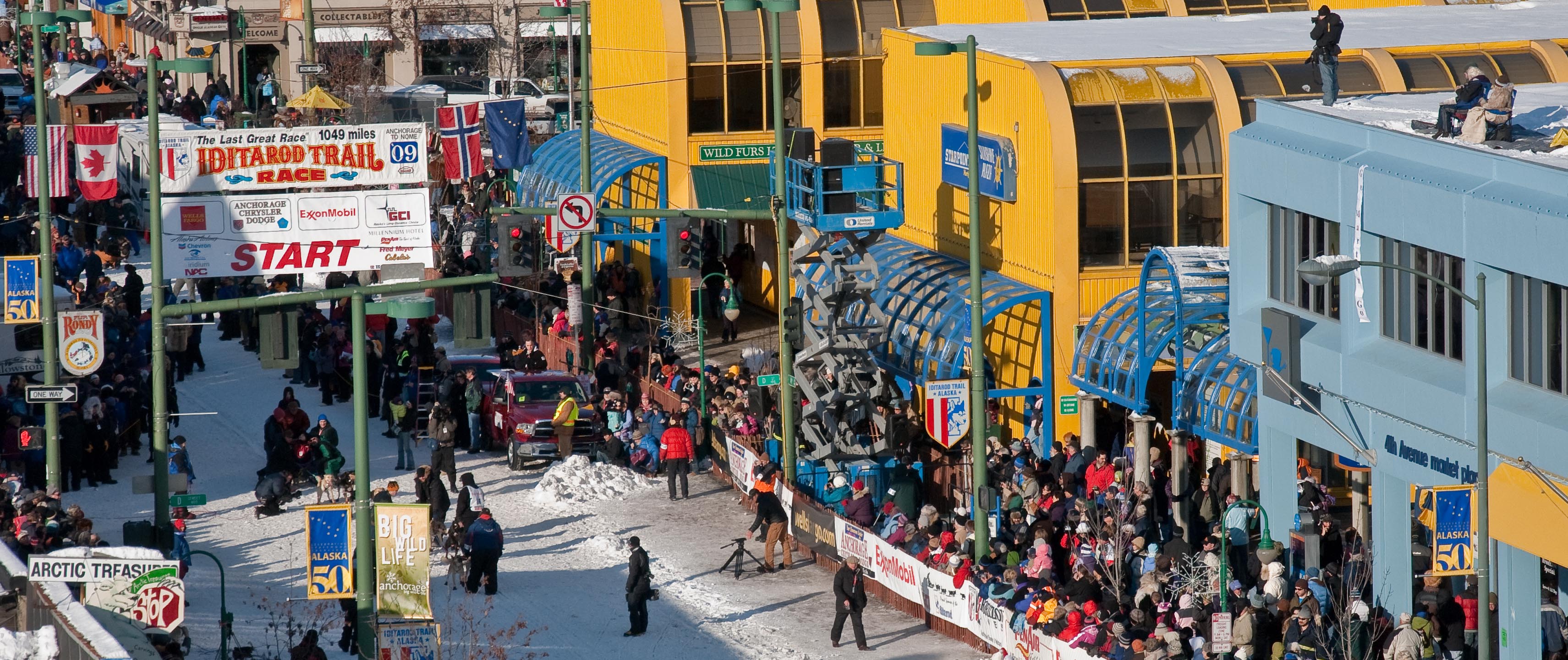
It may be true that over the years some mushers tried to force their dogs to go faster and longer through abusive behaviors. But after reading accounts by the mushers themselves, and by seeing the start of this year’s Iditarod, I sense there is often a strong bond between many mushers and their dogs.

Anchorage start of 2009 Iditarod

Start of the 2009 Iditarod in Anchorage

A prime example of this is Martin Buser, a four-time winner of the Iditarod and the holder of the fastest race time ever (8 days, 22 hours and 46 minutes, in 2002). In the book More Iditarod Classics, Buser spoke about the approach that gained him his first victory:

I never harped on negative discipline; I always harped on positive reinforcement. For a few years there was a lingering question of whether you could win with a soft-hand philosophy. Subsequently, that’s the new way. Our dogs run faster, last longer, live longer, and are happier the new way…At the finish line, only my dogs and I really knew how cool it was to be there the way we got there.

After Buser won two more Iditarods, his life became cluttered with the other responsibilities and projects that can be a by-product of such success. Then he got a wake-up call, by way of finishing 24th in the 2001 race. He realized that, while he had been doing all of the usual preparations and training beforehand, his focus was elsewhere:

I sort of forgot about the intuition and the closeness, and what had been cherished all of those years: the true camaraderie and intuition that I had with the dogs.

He responded by simplifying his life and getting back to that positive approach:

The whole season was for joy and fun…We did a lot of training that I had never done before. I made more loose runs than ever before, free-running the dogs, camping more than ever before.

That spirit carried on in the 2002 race itself. Buser’s philosophy was “If a guy goes to work happy, he does a much better job.” A case in point was his mandatory 24 hour layover, which he took as the first team into Cripple. Usually, a team’s dogs remain tethered together while they rest. Buser turned all of his dogs loose.

There’s not a lot of traffic, and there aren’t a lot of people. I stomped out a wider trench than normal. I just flaked out the straw and turned the dogs loose so they could be wherever they wanted. They could pick whomever they were sleeping next to, and they woke up and went to the sled and stole food and went back to their spot.

The people at the checkpoint couldn’t believe it. They would come to me and say, “Hey, you have a loose dog.” And I’d say, “I hope they’re all loose. I hope they didn’t chain themselves up.”

Even when the team encountered adverse conditions on the trail, whether breaking trail or pushing into a fierce wind, Buser’s dogs kept on flying. And in the end, thanks in good measure to his positive approach to training and racing, Buser and his team set the record for the fastest Iditarod ever.

Cim Smith and one of his leaders, at the start in Anchorage

Cim Smith and one of his lead dogs in Anchorage

We often hear talk of people sensing a kind of human energy: a team or performer is “energized by the crowd” or an artist is “energized by her latest work.” While we may not be able to explain it, we have a sense of what such talk about energy means. When we feel energized we are focused, alert, and motivated, feeling powerfully connected to an event, person or object with which we are relating. Conversely, at other times we will feel drained of energy from dealing with certain people or situations.

Those who have had training in certain fields – like yoga, martial arts, and occasionally psychology – may be particularly aware of this kind of energy. With enough training and practice, they may even be able to generate and channel it. The same can also be true of elite athletes.

A key factor in these situations is a sense of control. If we feel that we are actively involved in what’s happening and have control over our actions, we are more likely to feel motivated and energized. On the other hand, if we feel we don’t have any say in what happens and are basically doing what others say we should do, we are more likely to feel withdrawn and unmotivated. As Mihaly Csikszentmihalyi, author of the book “Flow: the Psychology of Optimal Experience,” once observed:

“Repression is not the way to virtue. When people restrain themselves out of fear, their lives are by necessity diminished. Only through freely chosen discipline can life be enjoyed and still kept within the bounds of reason.”

At times when we feel uncertain about ourselves or a situation, we have a tendency to focus on gaining control of things. But this is hardly ever effective. At best we provoke resentment; at worst we inspire active resistance. In any event, we are setting things up for eventual failure.

Instead of striving for control, perhaps we should try focusing on inspiration and motivation. Instead of only punishing bad behavior, we might try focusing on and promoting positive outcomes.

If we remember to inject some “joy and fun” into our activities, we’ll do more than just achieve our best performance. We’ll also be able to bask in knowing “how cool it was to be there the way we got there.”

===Photographs from 2009 Iditarod by Dave Higgins===

Posted in energy/flow, uncertainty | Tagged , | Leave a comment

Another Kind of Holistic Health

Back in the ’90s, while working in the traffic safety office of New York’s DMV, I apparently committed a Big Faux Pas. At a traffic safety panel discussion moderated by DMV’s second in command, I asked a question.

Traffic safety efforts are generally focused on one facet or another of safe driving: seat belts, drunk driving, drowsy driving, speeding, etc. I had the feeling that such a splintered approach was an ineffective way of doing things. So I asked the panel (through the moderator – Ms. DMV bigwig, remember) if anyone had thought of taking an holistic approach to traffic safety, considering how all these facets might interrelate.

There was a moment of silence, and our moderator appeared flustered by my question. After briefly looking like a deer caught in headlights (another traffic safety issue, by the way), she opened the question up to the panel. One panelist sprang to answer the question and explained that he would love to take such an approach, but the way studies were funded restricted them to focusing on one subject or another.

After the session ended, a colleague who worked at the Institute for Traffic Safety Management and Research (ITSMR) complimented me for a “great question.” I soon learned that Ms. DMV Bigwig didn’t share that sentiment. I encountered her in an office hallway a few days later. Recognizing me from the conference, she asked me whether I got a kick out of playing “stump the panel.” I said something bright like “Huh?” and she repeated her question.

I started to say something about how others had appreciated the question, and I hadn’t really stumped the panel anyway, seeing as a panelist had answered it. She cut me off, saying if she’d known I worked for DMV she never would have let me ask the panel a question. This statement raised some other issues in my mind, but I figured that wasn’t really a good time to raise them.

Apparently times have changed – at least in some fields – and we now have the One Health Initiative, which is “a worldwide strategy for expanding interdisciplinary collaborations and communications in all aspects of health care for humans and animals.” The idea is that since many modern diseases are exchanged between humans and animals, it makes sense to take an holistic approach to health that links various health fields together. As Medical News Today noted:

Zoonotic disease, diseases that strike both humans and animals, are perhaps the clearest inspiration for the One Health Initiative. Of the 35 new diseases that have struck since 1980, most are zoonotic diseases, including Ebola virus, monkey pox, West Nile virus, SARS, and HIV/AIDS. HIV/AIDS has killed an estimated 25 million people since it was first identified in 1981 and 40 million people worldwide are living with HIV/AIDS.

Their article goes on to quote Jay H Glasser, PhD, MS, FFPH,FRIPH, a professor at the University of Texas School of Public Health and president of the Medicine and Public Health Initiative. Said Dr. Glasser:

One Health is both a vision and a practicality that is so necessary and needed. We live in an age of an unprecedented explosion of health care knowledge, and health promotion and practice interventions. Yet it is also a time of equally enormous gaps in delivery and challenges to the human and animal health. In this age of our interconnected world where both local and global conditions interact with one another, where we are forcefully reminded that we are the custodians of our health and environment, One Health is indeed the embodiment of an “idea whose time has come.” One Health is more than a concept; it is apositive plan, and an organization to provide leadership and coordinated action to promote health – human, and animal – in today’s context where environmental and ecological sustainability is threatened.

This is just one example of a dawning awareness of the shortcomings of specialization and the need to consider an holistic approach to problems we face. Who knows? Maybe some day such an approach will even by tried in traffic safety.

Posted in holism | Tagged , | Leave a comment

Who’ll Pave the Roads?

It was great to hear the recent news that Albany’s Delaware Avenue would be repaved thanks to funds from the recent stimulus bill. That road, one of the main streets in Albany (NY), has been in sad shape for a long time.

Unfortunately, Delaware Avenue is not the only street around that needs a lot of help. Almost any community in the country has similar streets needing major work. And there are many other pieces of the country’s infrastructure – like water lines, for example – that are falling apart.

The Republican solution to any problem facing our country appears to be one thing: cut taxes.  As Republican Senator McCain said in discussing the stimulus:

“We need to make tax cuts permanent, and we need to make a commitment that there’ll be no new taxes,” Mr. McCain said. “We need to cut payroll taxes. We need to cut business taxes.”

In a column praising Louisiana Governor Bobby Jindal, the Washington Post’s Kathleen Parker notes Jindal’s comments on the Today Show the day after Obama’s speech to Congress:

Praising Obama’s objectives — while conceding that Republicans have lost fiscal credibility — he emphasized his preference for policies that help businesses create jobs rather than government programs he fears will require a taxpayer feeding tube in perpetuity.

While it’s important that businesses are able to create jobs, that isn’t the only factor in the quality of life for a community or a country. In today’s complex, inter-connected world, our quality of life is a product of many factors. Having a job feels very important these days. But so are having decent streets to drive on and decent water to drink (among other things).

Republicans like to claim they’d rather let you keep more of your own money, because you’ll have a better idea of how to spend it. But they never talk about the effect reduced revenues have on the world we live in.

In particular, how does giving me a tax cut get the roads paved and the water lines repaired?

Posted in holism, interconnected | Tagged , , | Leave a comment

E pluribus pluribus

E Pluribus Unum (Out of Many, One) – Seal of the United States

A big topic in today’s news was a rant by Rick Santelli, a hyper correspondent for CNBC who appears to believe yelling can compensate for a lack of sense.

The Atlantic’s Chris Good noted that this rant appeared to be part of a growing theme among Republicans/conservatives. For those folks, everything comes down to “American and Patriotic spirit; one that demands respect for individual rights and property.”

This rant is just one of many instances of an extreme individualistic bent common on the Right that has been promoted since at least the beginning of the Reagan era. The idea seems to be that individuals/corporations should be free to do whatever they want – materially, anyway – without any guff from government or the rest of society.

For people with this world view there is no sense of interconnection between individuals and other people, society in general, or the planet itself. Everyone is on their own, and let the chips fall where they may.

In this world, it appears perfectly reasonable to ask, as George Will recently did, “…it is mysterious whose interests, other than those of their shareholders, corporations are supposed to be controlled by.” Apparently the well-being of employees, neighbors or the nation that protects them and makes their very existence possible is irrelevant.

A mystery to me is what such followers of this “Church of Me” make of the motto in the Seal of the United States: E pluribus unum.  At what point do they mentally move from their many individuals to the greater one of the nation?

Surprisingly, conservative New York Times columnist David Brooks offers a helpful awareness of our interconnectedness in his column “Money for Idiots.” Concerning the Obama administration’s approach to the current crisis, he writes:

…they seem to understand the big thing. The nation’s economy is not just the sum of its individuals. It is an interwoven context that we all share. To stabilize that communal landscape, sometimes you have to shower money upon those who have been foolish or self-indulgent. The greedy idiots may be greedy idiots, but they are our countrymen. And at some level, we’re all in this together. If their lives don’t stabilize, then our lives don’t stabilize.

Unfortunately, Brooks betrays an underlying bias by referring to those facing foreclosure as greedy idiots. While there are indeed many greedy idiots involved, in actuality many people facing foreclosure on their homes are collateral damage of the current economic downturn. A more sensitive – and humorous – response to Santelli’s rant was provided by White House Press Secretary Robert Gibbs.

It’s reassuring to see that at least some people are maintaining an even keel during these trying times.

Posted in interconnected | Tagged , , | Leave a comment

Butterflies on Valentine’s Day

Does the flap of a butterfly’s wings in Brazil set off a tornado in Texas?  ~ Edward Lorenz

When you reach a certain age, you realize that there were certain moments in your past that significantly affected who and what you are. My life would be very different today if Mona at the Job Service office hadn’t told me back in the 70’s about an upcoming civil service test, or Becky at a friend’s party hadn’t persuaded me back in the 80’s to give aikido a try.

The same can also be true of relationships: looking back, you may realize that one person has had a profound effect on your life. For some, it might be a teacher or mentor; for me it was Susan.

I first met her on a ski weekend at Stowe in December, 1994. Each year about 100 of us go to Stowe to start the ski season off with skiing, lessons and camaraderie. Many of us have participated in this ritual for years, so new people tend to stand out. At the Thursday evening party that year, I noticed a cute blond standing by the fire; I went over and introduced myself.

I soon learned that her name was Susan and she lived in Rhode Island. Someone she knew through work, who lived in Michigan, had mentioned he was a regular at our clinic (the group comes from a variety of places around the country). She was interested in improving her skiing, so she signed up with the trip organizer. Her Michigan friend wound up not being able to attend the clinic that year, but Susan decided to go anyway.

I was intrigued by both her appearance and the way she spoke, and we wound up hitting it off. By the end of the weekend, we made plans to get together for New Year’s weekend. As things turned out, that second weekend together didn’t go quite so smoothly. While it ended on an awkward note, we still were attracted to each other and decided to keep in touch.

To make a long story short, we continued to see each other and our relationship grew. We dated for about two years, until the strains that often come with a long distance relationship took their toll. But even though we stopped dating, we’ve kept in touch – commiserating occasionally about work, relationships, skiing and life in general. Although our lives have gone in different directions, I still feel a special connection with Susan.

A few days ago, I was clearing out some files on my computer when I came across a copy of an email Susan had sent me a week after our bumpy New Year’s weekend. There were a number of things that struck me about that note, including her insight into some issues I was facing at the time and her generosity in focusing on what I was going through (rather than any irritations she may have felt about my behavior that weekend).

But beyond that was a sense of how far I’ve come since that time. Before then I had felt blocked and frustrated, having a sense of what might be called my “vision” but not knowing what to do about it. But thanks in great part to Susan’s encouragement and example, I’ve been able to get beyond that blockage and just do things I believe in, without too much concern about their outcome.

That can be a big step – especially when your ideas are out of the mainstream, as some of mine seem to be. But thanks to Susan, I went ahead and signed up for my first Pan-Mass Challenge. And thanks to her, I turned my offbeat ideas into my web site Quantum Age …and now this blog.

Edward Lorenz was a pioneer in chaos theory who coined the term “butterfly effect” to describe the phenomena in which small variations at one point in time can create a dramatic difference in outcomes. This is now a common subject in popular culture, even if some scientists feel it’s sometimes used incorrectly.

I believe it does have a usefulness in understanding how certain events or people can have a profound effect on our lives. The catch is we need to understand that it’s impossible to predict in advance which events or people will have that effect.

Last spring I was on a panel of former political science graduates at my college, Hobart & William Smith. Our task was to give current poli sci majors an idea of the range of career opportunities they might pursue with their degree. But one thing that struck me was the hunger many of them had to nail down a “right” answer to the question “What should I do?

Our panel tried to give our audience ideas, but I had the sense we weren’t really giving them what they wanted. What that was, it seemed, was certainty: the message that if you do such and such, everything will work out well in the end.

The problem is that life is always uncertain. For one thing, we don’t know how much the world will change over the course of our lives. When I graduated from Hobart in 1974, there was no way I could have known I would someday spend much of my working time on a personal computer, and include among my pasttimes creating and writing for a web site and blog. Such things hadn’t even been thought of back then. Beyond that, we have no idea what future events and people will come to have a profound effect on the direction our life will take.

I won’t presume to tell others how to live their lives. But personally, I believe there’s a value to not getting too hung up about the future. Instead, I believe it’s important to be aware of what is going on around you and what strikes a chord within you, and to then act. Maybe you won’t wind up wealthy and famous. Maybe others will even consider you a little peculiar. But if you are at one with yourself, that won’t really matter.

Who knows? Maybe some day you’ll be lucky enough to meet someone who will enrich your life in unpredictable ways.

Happy Valentine’s Day, Susita!

Posted in chaos, uncertainty | Tagged , | Leave a comment

Give a Little Nudge

When an opponent comes forward, move in and greet him;
if he wants to pull back, send him on his way.
~ Morihei Ueshiba

In the martial art of aikido, a guiding principle is to take an opponent’s focus and redirect it towards a more positive result. Instead of trying to control him, you “send him on his way.” To the average person this can sound rather New Agey and overly optimistic. But if you have trained enough in aikido to be aware of the energy dynamics and ethics involved, it is totally reasonable.

Modern physics teaches that at the most elemental level, everything in the universe is energy. By the same token, we frequently sense people in terms of energy. We’ll say someone is an energetic speaker, or complain that we have a lack of energy today. And if we are excited about doing something, we might say we are “energized.”

As with aikido, some people are using a sense of energy dynamics to propose new ways of promoting positve behavior. Rather than trying to direct or prevent behavior in a mechanical, command and control way, they are proposing more subtle approaches that channel people’s direction.

A novel example of this can be found in a New York Times article titled “When Humans Need a Nudge Toward Rationality”:

THE flies in the men’s-room urinals of the Amsterdam airport have been enshrined in the academic literature on economics and psychology. The flies — images of flies, actually — were etched in the porcelain near the urinal drains in an experiment in human behavior.

After the flies were added, “spillage” on the men’s-room floor fell by 80 percent. “Men evidently like to aim at targets,” said Richard Thaler of the University of Chicago, an irreverent pioneer in the increasingly influential field of behavioral economics.

Mr. Thaler says the flies are his favorite example of a “nudge” — a harmless bit of engineering that manages to “attract people’s attention and alter their behavior in a positive way, without actually requiring anyone to do anything at all.” What’s more, he said, “The flies are fun.”

urinal-fly

Actually, there are many other examples available on the Nudge blog. And frankly, one reason I was interested in this story is that I proposed a similar approach to traffic safety many years ago.

The bottom line is, “nudging” (or whatever you want to call the approach) is a promising way of promoting positive behaviors in many ways – certainly more than just keeping men’s room floors dry.

Posted in energy/flow | Tagged , | Leave a comment

Of Moles and Squeegee Men

Now that January 20th has come and gone, the Bush League has departed from DC like unruly guests who cleaned out the liquor cabinet and the wine cellar and generally trashed the place. As we start to pick up the pieces and straighten the furniture, a question persists: should we call the cops or should we just pretend it never happened?

Many of the DC regulars want to make pretend and “just get on with things.” As Glenn Greenwald noted:

There are few viewpoints, if there are any, which trigger more fervent agreement across the political and media establishment than the view that George Bush, Dick Cheney and other top officials should not be criminally investigated, let alone prosecuted, for the various laws they have broken over the last eight years.

The reasoning for this “let bygones be bygones” comes in a variety of flavors. The Washington Post’s Richard Cohen argued that the Devil (aka Osama bin Laden) made us forget ourselves and our constitution and begin jailing people without charges and then torturing them:

“The past is a foreign country; they do things differently there.” So goes an aphorism that needs to be applied to the current debate over whether those who authorized and used torture should be prosecuted. In the very different country called Sept. 11, 2001, the answer would be a resounding no.

Cohen’s Post colleauge Ruth Marcus, on the other hand, strikes a pragmatic pose
:

I’m coming to the conclusion that what’s most crucial here is ensuring that these mistakes are not repeated. In the end, that may be more important than punishing those who acted wrongly in pursuit of what they thought was right.

Mr. Greenwald is outraged by this attitude because the Justice Department continues to hound the lawyer-mole who first told a New York Times reporter about Bush’s illegal NSA spying program. It certainly seems unfair to persecute an individual for revealing criminal and unconstitutional behavior at the same time pundits and politicians want to give the “evil doers” a free pass.

The New York Times’ Frank Rich also supports investigation and possible prosecution, to regain our country’s honor:

While our new president indeed must move on and address the urgent crises that cannot wait, Bush administration malfeasance can’t be merely forgotten or finessed.

Beyond the whole matter of being a nation of laws and all, Mr. Rich argues we need to address the problems of the past to gain guidance for the future:

But I would add that we need full disclosure of the more prosaic governmental corruption of the Bush years, too, for pragmatic domestic reasons. To make the policy decisions ahead of us in the economic meltdown, we must know what went wrong along the way in the executive and legislative branches alike.

Greenwald and Rich make strong points in favor of actually investigating what happened over the past eight years, and prosecuting those who broke the law. But their points are not the only – or even most – important reasons for investigation and prosecution. To understand what’s at stake here, we need to remember the squeegee men.


Back in March of 1982, The Atlantic magazine featured an article by George Kelling and James Wilson, titled “Broken Windows.” Kelling and Wilson argued that the perception of a social breakdown will lead to the reality of that breakdown:

…at the community level, disorder and crime are usually inextricably linked, in a kind of developmental sequence. Social psychologists and police officers tend to agree that if a window in a building is broken and is left unrepaired, all the rest of the windows will soon be broken. This is as true in nice neighborhoods as in rundown ones. Window-breaking does not necessarily occur on a large scale because some areas are inhabited by determined window-breakers whereas others are populated by window-lovers; rather, one unrepaired broken window is a signal that no one cares, and so breaking more windows costs nothing. (It has always been fun.)

Kelling and Wilson wrote about experiments reported on by Stanford psychologist Philip Zimbardo, who arranged to have apparently abandoned vehicles parked on streets in the Bronx, NY and Palo Alto, CA. While the time frames differed, the result was the same: both cars wound up being vandalized and destroyed. Kelling and Wilson wrote:

…vandalism can occur anywhere once communal barriers—the sense of mutual regard and the obligations of civility—are lowered by actions that seem to signal that “no one cares.”

This article eventually led to a then-new approach to community policing in which minor offenses were dealt with thoroughly, with the idea that by discouraging disorderly behavior there would be an increase in social order. The most famous – or notorious, depending on your point of view – case of this was in New York City, where Mayor Rudy Giuliani gained fame for such tactics as cracking down on squeegee men. This approach was eventually credited with a significant decline in the general crime rate in New York City.

It’s common to believe that illegal or anti-social behavior is rooted in individual morality: good people behave in good ways, while bad people behave badly. But that’s not necessarily so. As Kelling and Wilson (and others) have found, individual behavior is often influenced by how that individual sees others behave. If boundaries are pushed and nothing happens to the wrong-doers, then the threshold for anti-social or illegal behavior shifts. If someone vandalizes a car and nothing happens, soon others will follow suit. If one Wall Street firm games the system and nothing happens, you know it’s only a matter of time before others start behaving the same way.

This is really nothing new. Who hasn’t, as a child, tried to do something because “everyone else is doing it”? And who hasn’t had their mother or father reply something to the effect: “If everyone else jumps off a cliff, are you going to jump off a cliff?” While we may tell ourselves that adults act differently, history (and the fashion industry) proves that our behavior frequently reflects that of those around us.

While it might be politically convenient to disregard any possible criminal behavior by members of the Bush administration, “letting bygone be bygones” will send a terrible message to the rest of our citizens – as well as the world. It will be saying “we don’t care” about violations of our constitution, international law, and the fundamental idea of human decency.

Ruth Marcus may wish to disregard the particulars and just ensure “that these mistakes are not repeated.” But by blithely ignoring them, we’re likely to guarantee such behavior will someday return.

Posted in dual nature | Tagged , , , , | Leave a comment

What Do Libertarian Farmers Grow?

Washington Post writer and blogger Joel Achenbach recently wrote a piece called “Inventing the Future” for his alumni publication. It’s about a brainy fellow Princeton alum named Nathan Myhrvold, who according to Achenbach is brilliant in many areas – physics, software design, cooking, photography, etc. In his article, one quote by Myhrvold caught my attention:

“Broadly, overall, the way society works is emergent, and it is built on progress — it generally runs downhill toward something better,” Myhrvold says as we get deep into the philosophical weeds on all this stuff. The world is a better place now than it was 500 years ago, he declares. Driving that improvement is, he believes, technology. He’s an unabashed technophile. And he seems to have a strong libertarian streak.

A taste of that libertarian streak comes out a couple paragraphs later:

Many of the visionaries today talk of building a “sustainable” society, a word that seems to rile Myhrvold. “The most sustainable thing about human society is that we innovate,” he says. Later, he elaborates in an e-mail: “The answer is not to pine for a past golden age when things were better (there was no such place or time), but rather to ask how we can use more technology and innovation.” Change, he thinks, is intrinsic to our nature. The future will be different. Survival will not involve preservation of things as they existed before: It will require their creative destruction and replacement.

OK…first of all, I’d love to see a debate between Mr. Myhrvold (aka Mr. T – as in Technology) and James Kunstler (aka Mr. Doomed – as in “we all are…”). They both sound bright and opinionated, and they share an interest in predicting the future. But one expresses great optimism about technolgy and the future, while the other is generally very pessimistic. It would be a fun debate – in an intellectual “fight club” kind of way.

Beyond that, up to a point I agree with Mr. Myhrvold about society being emergent: the way a society is and the way people behave in it develops from the bottom up. However, I believe this is only a part of the picture.

I suspect Myhrvold’s sense of emergence is at the heart of a lot of libertarian thought: “just get out of the way and let things emerge!” Libertarians apparently assume things exist in some vaguely positive state – sort of a social petri dish filled with a fertile growth medium. Given that neutral state, things will always work out for the best eventually. If and when they don’t – like the current financial crisis – libertarians just write it off as “creative destruction.”

There are indeed cases in which The Old must collapse in order for The New to come to fruition. (After all, that’s one of the main ideas behind this blog and my website,) But as we’ve seen too often recently, destruction can often be a product of stupidity or greed rather than creativity.

What Myhrvold and other libertarians fail to recognize is the other side of the bottom-up nature of emergence. Things don’t just emerge willy nilly out of nothing; they emerge in a context. The environment in which they exist will usually play a huge role in their outcome.

Take farming, for example. What a farmer grows and how successful he or she is in growing it will largely be determined by the context of his or her farm: the climate, the soil, water availability, general nature of the land, etc. Any farmer who tries to grow corn in the mountains of Colombia is likely to have as little success as one trying to grow coffee in Iowa.

Crops are an emergent phenomena; a farmer may plant the seeds, but then nature takes over. However, the farmer’s success depends on him or her being mindful of the context of the farm and the crops that are most likely to thrive in it for a sustainable period of time. In addition, to get the most productive crop the farmer must keep in mind the specific needs – water, nutrition, etc. – of the crop over the course of the growing season. Otherwise, under/over-fertilization or a drought can have a serious effect on the yield of the crop.

In the same way, individuals and businesses exist within the context of human society. That society, in turn, exists within the larger context of the local and global physical environment. We are each a part of the world, not apart from it.

This may be easier to understand if we borrow an idea from modern science. Physics has found that at its most elementary level, matter is simultaneously an individual particle and part of a collective wave. It’s dual-natured.

The same is true of people and businesses: we are not just a solitary individual or a part of the group. We are always both at the same time. It’s just a matter of perception, like watching a crowd doing a “wave” in a packed stadium. You can watch the wave of humanity roll around the stadium or you can watch a person participate by standing up and then sitting down with those around them. But you can never see both at the same time.

The problem with libertarianism is that by always being focused on the individual it is blind to context. It’s all particle and no wave. At that stadium, it would see a person getting up and sitting down; it wouldn’t see the wave that individual was a part of. On Wall Street the focus was only on the success of individuals; there was no thought of the way the behavior of those individuals was damaging the financial system as a whole. No wonder so many “experts” were caught off guard by the inevitable collapse. They literally never saw it coming.

If a person tried to farm with a libertarian’s blindness to context, they’d most likely lose the farm in short order. They would plant whatever they thought would be most profitable, regardless of its suitability for local climate and soil. Once planted, the crop would be at the mercy of the “invisible hand” of nature. Maybe it would rain, maybe it wouldn’t; being averse to “regulatory meddling,” it would be against libertarian ideology to alter the natural course of things by watering.

With a blindness to context and an aversion to “meddling,” there’s only one crop a libertarian would be likely to have by the end of a growing season: weeds.

Posted in dual nature, emergent | Tagged , , | Leave a comment