Fighting the System

It’s all well and good to take a systems approach to fixing systems. But it’s important to realize that the biggest obstacle to repairing a system is often ingrained in the system itself. The bigger and the more widely it’s used, the more its users are likely to resist change – even if they are the ones who demanded it in the first place.

I’ve recently been involved in coming up with improvements to the Policy System at where I work. One of the complaints we’ve heard from system users is that the current system is too complicated: among other things, it’s not clear what you have to do for internal policies as opposed to those that affect the public. (It appears that some of this confusion has come from people not reading the policy that spells out the Policy System, but that’s a whole other matter.)

My boss had an idea for simplifying the system that would have been simple and straightforward: external policies would be of one type; internal policies would be of another. The only problem was this change would have left many current policies out of synch with the new framework. When he presented this idea to the Department’s leadership, they objected to this disruption to their part of the system. Apparently, they wanted things simplified without making any major changes to the system.

This kind of reaction is not uncommon in changing systems. People have problems with parts of a system and think “there has to be a better way.” They may very well be right. But the thing about systems is that they tend to have many users who have different perspectives on what the system is supposed to accomplish.

To take the current debate over reforming the American health care system as an example, different groups of users expect different things from the current system, as well as from any new system that might eventually replace it. Patients expect it to help them stay or get healthy; doctors expect it to provide sufficient payment for their services; insurers expect to take in enough money to cover their costs and risks and still make a profit.

Swirling around this system is something else that influences the nature of the system: a cloud of beliefs, ideologies and expectations about how the world is and should be, and how the health care system should fit into that world. Some people feel a moral obligation to help those in need; others feel each person is responsible for his or her own well-being, and let the chips fall where they may. Some may feel that it’s immoral for anyone to profit off the health problems of those in need of care; others may feel that the Market is the fairest arbiter of morality, rewarding the deserving and punishing the lazy.

And under all of this is an understanding of how the system is supposed to work that’s grounded in past experience: if we get sick we should go to a doctor; if we need them we should get drugs that will make us better; and if we are seriously injured or sick we should go to a hospital. Most of us don’t question our understanding – whether we really need all the drugs we take, for example.

The end result is that even when we can see that the current system is not sustainable – that it’s overly expensive and inefficient, if not immoral – any proposed changes have to run through the gamut of our expectations, beliefs, and set prejudices for the current system.

Resistance to change in a system is natural and to be expected. The question is how do we get past this resistance?

In her book “Leadership and the New Science,” Margaret Wheatley turned to quantum physics for an answer. She drew on the fact that in the quantum world things go from a state of potentiality to one of actuality through the act of observation: an electron is both a particle and a wave until it’s measured. The act of measurement – observation – finds it as either one or the other. With this in mind, Wheatley argued that the only way to successfully create change was to get those who will have to act on a plan involved in its creation:

This is where the observation phenomenon of quantum physics has something to teach us. In quantum logic, it is impossible to expect any plan or idea to be real to employees if they do not have the opportunity to personally interact with it. Reality emerges from our process of observation, from decisions we the observers make about what we will see. It does not exist independent of those activities. Therefore, we cannot talk people into reality because there truly is no reality to describe if they haven’t been there. People can only become aware of the reality of the plan by interacting with it, by creating different possibilities through their personal processes of observation.

Wheatley went on to say “…it is the participation process that generates the reality to which they then make their commitment.”

One of the major points of debate over the past year is about President Obama “letting” Congress take the initiative in writing the health care reform bills. There have been those who have criticized the President for not just creating the legislation and then dumping it on Congress, much the way the Clinton Administration did with their health care reform bill.

But Norman Ornstein praised President Obama’s approach in a Washington Post op-ed piece, describing it in terms similar to Wheatley’s description of participative change:

How to prevail under these difficult circumstances? The only realistic way was to avoid a bill of particulars, to stay flexible, and to rely on congressional party and committee leaders in both houses to find the sweet spots to get bills through individual House and Senate obstacle courses. Under these circumstances, the best intervention from the White House is to help break impasses when they arise and, toward the end, the presidential bully pulpit and the president’s political capital can help to seal the deal.

Politicians have talked for many years about the need to reform the American health care system. Perhaps the reason why we finally have health care reform bills that passed in both the House and the Senate is that a former community organizer was familiar with the idea of getting buy-in through participation.

To successfully fix a system, you have to know how to fight it.
Posted in holism | Tagged , , , | Leave a comment

Fixing the System

Many of the problems confronting the US today involve systems that aren’t working properly. Examples that come to mind include financial services (the banks), the economy in general, American healthcare, the governments in Afghanistan and Iraq, and global climate change.

In the recent past the solutions offered for such problems were simple and straightforward: deregulate, cut taxes, create healthcare savings accounts, change regimes, and…well, the Bush administration didn’t really talk much about climate change. Unfortunately, these solutions didn’t solve these problems. In fact, in many cases the problems only got worse. (A prime example would be Wall Street, in which deregulation enabled the buildup of some of the problems that led to last year’s financial meltdown.)

In today’s world we need to understand that problems with systems cannot be solved by simple-minded solutions that ignore the dynamics of the system. To adequately address such problems, we need to address the system as a system.

I don’t often agree with the NY Times’ David Brooks; I’ve found he can be perceptive in identifying an issue, but then his ideology often steers him away from what I consider to be reasonable solutions. But I was intrigued by an observation he made in today’s Times:

…there are several things the government can do to improve the economic ecology.

I wasn’t intrigued by a conservative columnist actually saying the government can do something – though that can be a bit of a shocker. What I found interesting was his term “economic ecology.” I don’t think he was talking in terms of ecological economics, which focuses on the interrelationship of economics with societies and the environment. I think he was just talking in terms of the economy as a living system.

It’s not clear in Brooks’ column if the solutions he lists are from a report from President Obama’s National Economic Council that he mentioned in the column, or if they are from Brooks himself. But they do appear to be focused on ways to enhance the economy as a system, much the way a farmer might improve his fields to increase the chances of a better harvest. Rather than having to choose between government control and market chaos, the solutions Brooks lists are aimed at letting progress emerge naturally:

This sort of agenda doesn’t rely on politicians who think they can predict the next new thing. Nor does it mean merely letting the market go its own way. (The market seems to have a preference for useless financial instruments and insane compensation packages.)

Instead, it’s an agenda that would steer and spark innovation without controlling it, which is what government has done since the days of Alexander Hamilton. It’s the sort of thing the country does periodically, each time we need to recover from one of our binges of national stupidity.

In a similar vein, the Washington Post’s Ezra Klein takes a systems-based look at one aspect of America’s healthcare system: employer-provided health insurance. Specifically, Klein looks at the relationship between this insurance benefit and employee wages, and how people’s perception of that relationship can shape how they feel about controlling healthcare costs:

But health-care coverage is not a benefit. It’s a wage deduction. When premium costs go up, wages go down. When premium costs go down, wages go up. Yet workers don’t know that. In fact, the information is hidden from them. That means that cost control seems like all pain and no gain, which makes it virtually impossible for Congress to pass. It’s like asking someone to diet when they don’t realize it will help them lose weight.

Like Brooks, Klein presents a possible solution that doesn’t seek direct control of anyone’s behavior, but instead strives to increase people’s understanding of the system:

Perhaps the easiest way to dramatize the issue for workers would be to attach health-care costs to each paycheck. If employers listed the cost of health care alongside the bite taken by payroll taxes, it would be much clearer to workers that health-care coverage was coming out of their wages, not out of their employer’s largess. That, at least, could help them see the costs of the system more clearly, which is, unfortunately, something that all the congressional debate isn’t helping anyone do.

The expectation inherent in Klein’s solution is that an increased understanding of the system would lead people to see their own interest in increasing the system’s efficiency and sustainability.

With so many systems in crisis in our world today, it’s heartening to see that at least some of the solutions being discussed reflect at least some awareness of system dynamics.

Posted in complexity, emergent, holism | Tagged , , | Leave a comment

The Linkage Is Blowing In The Wind

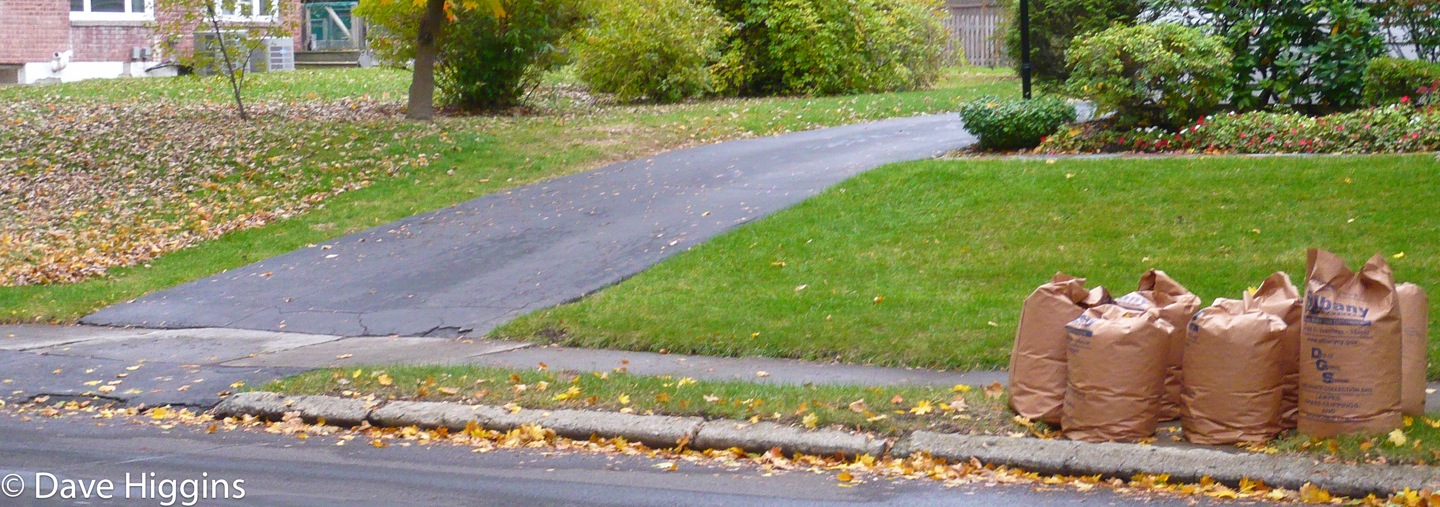
We had a beautiful November evening here today, so after work I took a walk through some area neighborhoods. After the weekend’s wind and cold, most of the leaves are now off the trees.

As I walked along I saw numerous people out raking and bagging leaves. It was interesting to notice the varying states of peoples’ yards. Some were immaculate – not a leaf was left on the grass. Others had leaves strewn about, but you could tell the yard had been raked at some point over the weekend. And then there were some yards that were covered by every leaf that had grown all season on the overhead branches.

leaf line between two yards

I noticed that the borders between different yards were often clearly defined: it was like there were lines drawn, with neat and cleared grass on one side and leaves in various states of decay on the other. These borders seemed to be a clear example of an American sense of responsibility that is inherently individualistic: “I’m responsible for mine; you’re responsible for yours.”

I understand this perspective, because that’s generally the way I’ve cleared my yard. (I’m lazy though: I use a lawn mower with a bag attachment to pick up the leaves.) The one problem with this perspective is it’s arbitrary; it doesn’t fit with the way nature does things.

And so, on days like this past Saturday, the wind picks up dramatically and gusts blow the uncollected leaves to and fro, down the street and into everyone else’s yard. And then the owners of the neat yards start thinking dark thoughts about the owners of the leafy yards: those lazy bums whose leaves have now blown onto those (until recently) neat yards.

Remember the anger expressed in those August town hall meetings on health care reform? The message was clearly “I am not my brother’s keeper.” And that would go double for people “too lazy” to pick up their leaves. And so the anger builds…

But as I walked this evening I realized those windy days serve another purpose: they  remind us that in spite of our arbitrary boundaries we are all linked together in this natural world. While we may get angry at our neighbors for not conforming to our sense of orderliness, they’re not the ones who created the leaves and dictated that they will turn and drop in November. That’s just the way nature does things. Why don’t we get mad at nature? Could it be because that sounds silly – like getting mad at the tide for coming in?

Maybe we need to realize that into each of our lives some leaves will fall…and then maybe blow around for a while. Being linked together, both as neighbors and as humans trying to live in a shared natural world, we might try being considerate of those around us and do something about our leaves. But if for whatever reason some people won’t or can’t, maybe we should just try to find the positive in the situation.

After all, the physical activity associated with leaf collection is probably good for us – especially at a dark and cold time of year when many of us are getting less exercise. And I suspect that wind is really nature’s way of tucking trees and shrubs in for the winter, with a leafy blanket around their roots to hold in moisture and warmth. (Though this blanket can cause other problems.)

So I’ll try to keep all this in mind the next time the winds blow and the uncollected leaves from the house three doors down my street come bounding into my yard. And we’ll see if that changes my perspective on those lazy bums – er, unenlightened individuals.

Posted in interconnected, quanta | Tagged , | Leave a comment

You Can’t Believe Your Eyes

CNN’s web site recently had a piece called “Don’t believe your lying eyes” by R. Beau Lotto. Lotto, the founder of a hybrid art studio and science lab in London called Lottolab, says that what we see is not necessarily what we are actually looking at:

Seeing lightness and color are the simplest sensations the brain has. And yet even at this most basic level we never see the light that falls onto our eyes (called the retinal image) or even the real-world source of that image.

Rather, neuroscience research tells us that we only ever see what proved useful to see in the past. Illusions are a simple but powerful example of this point. Like all our perceptions, we see illusions because the brain evolved not to see the retinal image, but to resolve the inherent “meaninglessness” of that image by continually redefining normality, a normality that is necessarily grounded in relationships, history and ecology.

He argues that this fact is a key to understanding ourselves and the world around us:

Understanding this point is I believe critical to personal and social well-being, since the typical barrier to a deeper insight into oneself and others is the overriding, but necessarily false impression that what “I” see, what “I” hear and what “I” know is the world as it really is.

While Lotto’s work appears to be just one more example of the uncertainty that seems to ripple through so much of life today, it may help us actually deal with it:

Resolving uncertainty is essential to our survival. Hence our fear of ambiguous situations is palpable — e.g., the inability to resolve sensory conflict between the eyes and ears can result in nausea (like seasickness). And yet it is only by embracing the unknown within education, science, art and most importantly within our own private lives that we will find new routes to more enlightened ways of seeing and being.

Posted in quanta, uncertainty | Tagged | Leave a comment

They’rrr baaack!

Back in May I had a post about the visit to Albany by the film crew for the Angelina Jolie movie Salt. Apparently Albany is a prime place these days for shooting chase scenes, because now we have a crew in town to shoot scenes for the Will Ferrel/Mark Wahlberg movie The Other Guys. While the movie is a buddy cop flick set in New York City, apparently some of Albany’s streets can serve as stand-ins in a pinch.

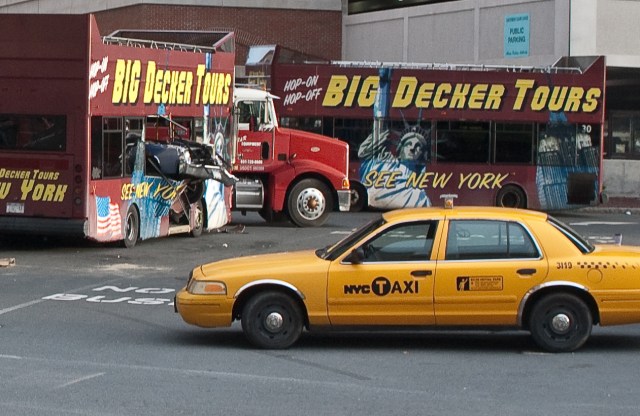
This movie’s different from Salt in that there’s much more shooting and crashing of cars – and buses – involved. (The only crashing I saw on the Salt set was when the driver of an SUV absentmindedly backed into a guardrail after a take.) On the first day of shooting for The Other Guys, a parking lot next to my building was filled with shiny multiple copies of different cars and SUVs, as well as a healthy supply of NYC yellow cabs and NYPD squad cars. As time goes on, the lot seems to be gradually morphing into a junkyard, with a growing variety of banged up cars and buses.

Various prop vehicles, including a tour bus that has been speared by a Chevy Malibu

Various prop vehicles, including a tour bus that's been speared by a Chevy Malibu

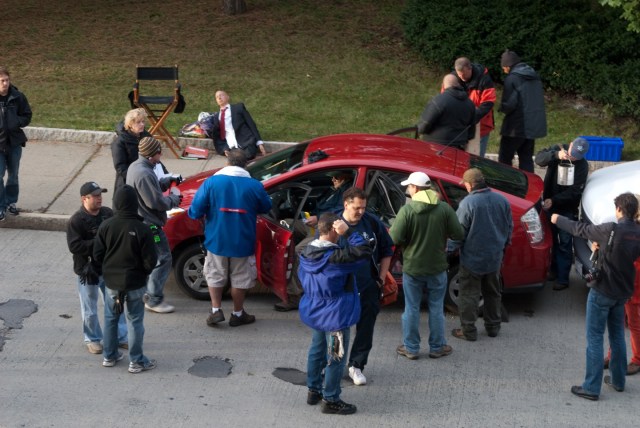
Today’s shooting was right outside my office windows, so the day was occasionally punctuated by the sounds of squealing tires and the curiously roaring engine of a Toyota Prius. (I have NEVER heard a Prius sound like this one…and what’s with having a Prius in a chase scene?) Intentionally of not, it appeared the Prius made it through the day unscathed, even if it came close at times to either spinning into a curb or sideswiping some other car or truck. But that’s OK – they have three more identical red Priuses, all with primer gray right rear doors. Something tells me bad things are going to happen to at least a couple of those cars…

Lots of people gathered around the star Prius, getting it ready for the day's shooting.

Lots of people gathered around the star Prius, getting it ready for the day's shooting. Note the suited dummy in the background - it's probably not going to be a good day for him either.

Much of what I said back in May still holds true – the altered reality of a Hollywood production tends to alter your perspective on everyday sights. It also can raise questions about what is “real” versus what’s just part of the movie set. A recently installed sculpture in a nearby park raised the question “was it part of the movie, or was it a new part of the park?

However this time I seem to have a new perspective on all the goings-on: a sense of deja vu. Having seen similar activities only 4 months ago, there’s not as much novelty this time around. In spite of the occasional sounds of squealing tires and automatic weapons fire, I find myself feeling a growing ennui about the whole enterprise. I feel kind of like a New Yorker trying to wade through a crowd of tourists gawking at the towering skyscrapers looming overhead; I’ve seen this all before and just want to get on with my daily routine.

It’s almost like I’m adopting a New York mindset to this pseudo-New York film shoot. Talk about movies altering our reality…

Posted in relativity | Tagged , | Leave a comment

As We Are Now

This post is now also part of my new blog Dave Higgins Photography.

*****************

From my early childhood, I remember numerous family visits to cemeteries. It wasn’t that we were abnormally morbid, or a large family with many relatives who had already “passed on.” In fact, we didn’t know any of the people whose markers we examined.

(Well, mostly. There are interesting gravestones of some family ancestors who were “murdered in a most brutal and cold-blooded manner” in New Jersey on May 1, 1843 – a story still talked about today. Miraculously, two children survived that massacre.)

Anyway, my family was doing something that’s not uncommon in New England: checking out old gravestones. Since my father had been a history major in college and his parents lived in New England, it seemed natural that we should find ourselves exploring old cemeteries, looking for memorable epitaphs and designs.

Beyond the consideration of their aesthetics, gravestones and monuments offer us windows into the lives and cultures of other people from other times. In summing up individual lives, cemetery art tells us something about what people of a certain time and place collectively valued and how they defined their lives.

Around 1980 I discovered that some modern gravestones featured something of a revival in gravestone art. Since about the start of the Industrial Revolution, gravestones mostly offered the basic facts: name, date of birth and date of death. But in the 1970s gravestones began to feature art work that told us something more about the person or persons they marked. This included images of worldly possessions or pastimes, representations of work occupations, and notes either from or to the deceased.

I took a lot of photographs of these gravestones in the early 80s, but then dropped the project as my attentions focused on other aspects of my life. Last fall, equipped with a new digital camera and visiting my sister in Texas, we explored some local cemeteries and found that modern gravestone art has flourished. I have been taking photographs of these gravestones ever since.

What are today’s gravestones telling future generations about us? And what does that tell us about ourselves? That’s what I’m exploring with these photographs.

The title of the project – “As We Are Now” – comes from part of a popular epitaph on old New England gravestones:

“Stranger pause, as you pass by. As you are now so once was I. As I am now so you must be. Prepare for death and follow me.”

My approach of photographing these gravestones in color on sunny days was inspired by a more recent observation of modern life, taken from the Beatles:

“Penny Lane is in my ears and in my eyes, here beneath the blue suburban skies.”

Here’s an initial sampling of photos.

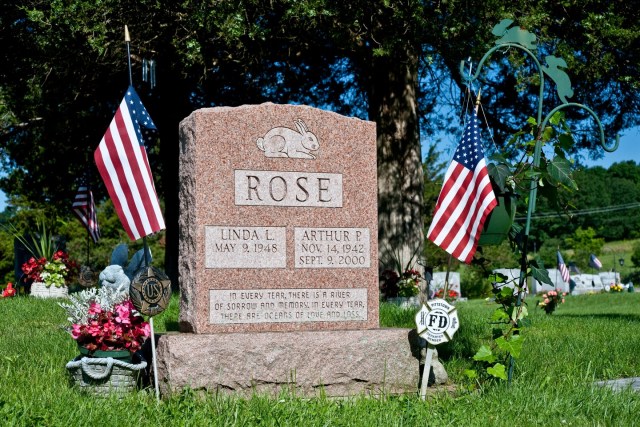
Rabbits - Pittstown, NY

Rabbits - Pittstown, NY 7/6/2009

“In every tear, there is a river of sorrow and memory. In every tear, there are oceans of love and loss.”

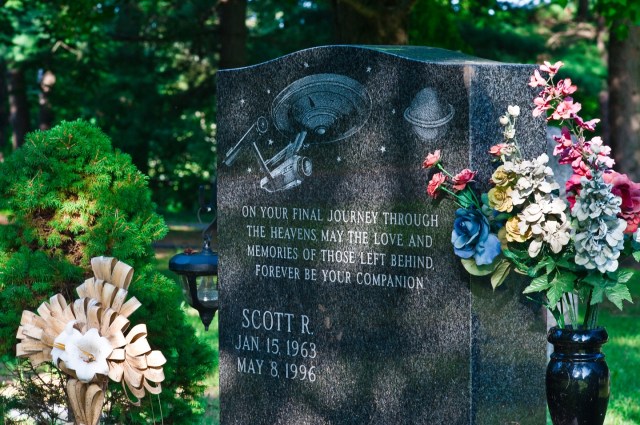
Enterprise - Delmar, NY  8/17/2009

Enterprise - Delmar, NY 8/17/2009

Shopping Cart, Albany, NY 5/23/2009

Shopping Cart - Albany, NY 5/23/2009

House, Colonie, NY  5/13/2009

House - Colonie, NY 5/13/2009

Fishing, Schodack, NY  5/22/2009

Fishing - Schodack, NY 5/22/2009

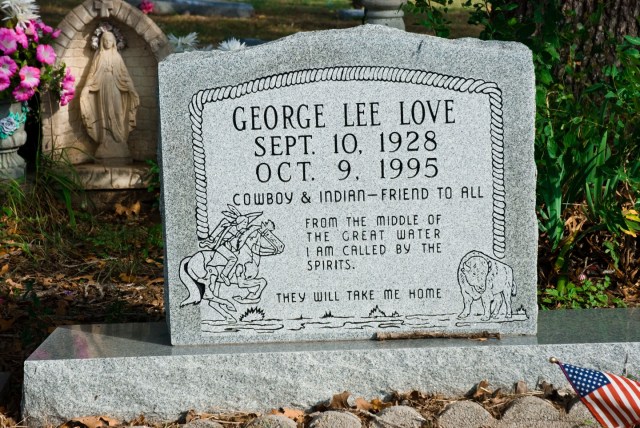
Cowboy & Indian - Joshua, TX 10/16/2008

Cowboy & Indian - Joshua, TX 10/16/2008

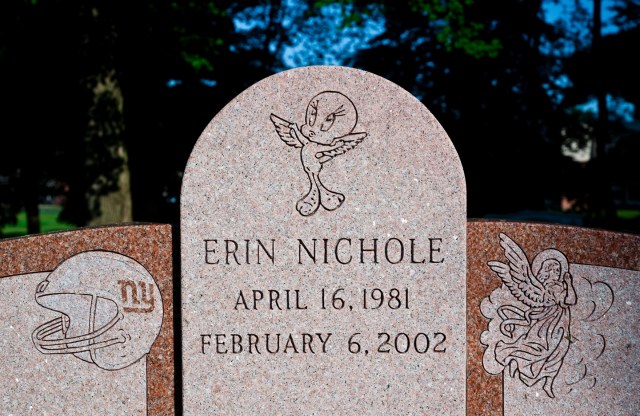
Tweety as Angel, Delmar, NY  8/7/2009

Tweety as Angel - Delmar, NY 8/7/2009

The last gravestone, featuring the cartoon Tweety Bird as an angel, is an interesting contrast to early New England gravestone imagery.

**************************

All photographs are copyrighted by Dave Higgins; all rights reserved.

Posted in As We Are Now, dual nature | Tagged , , | 1 Comment

What We Measure Is What We’ll Get

Many people share the belief that there is a solid, objective reality “out there” somewhere – outside our heads, presumably – and that we can perceive this reality by assuming a detached, objective approach to understanding things. It’s also assumed that numbers, being abstract and seemingly objective themselves, are a key ingredient in achieving an objective knowledge about, well, things.

And so we hear every day a litany of numbers – the Dow Jones indices, unemployment rates, durable goods orders, interest rates, the GDP, etc. – from which we are supposed to conclude (objectively, of course) how we are doing economically. Being Americans, it’s taken as a given that if we’re doing well economically, then we’re doing well in general and all is right with the world.

The only problem is that our faith in the value of objectivity is just that – an article of faith. We don’t have any way of proving that our presumed objectivity, and objective reality, are the be all and end all of things.

As it turns out, quantum physics has discovered that reality can be understood in a number of ways, but it is not just some giant slab of objective Truth. As is demonstrated by the famous double slit experiment, what we measure for will have a major influence on what we get.

I was reminded of this fact by a piece in the New York Times titled G.D.P. R.I.P. The author, Eric Zencey, argues that using the Gross Domestic Product as a way to measure our economic well-being is flawed because it is incomplete. Only certain things are measured by the GDP:

A mundane example: If you let the sun dry your clothes, the service is free and doesn’t show up in our domestic product; if you throw your laundry in the dryer, you burn fossil fuel, increase your carbon footprint, make the economy more unsustainable — and give G.D.P. a bit of a bump.

The incompleteness of the GDP winds up shaping our priorities:

In general, the replacement of natural-capital services (like sun-drying clothes, or the propagation of fish, or flood control and water purification) with built-capital services (like those from a clothes dryer, or an industrial fish farm, or from levees, dams and treatment plants) is a bad trade — built capital is costly, doesn’t maintain itself, and in many cases provides an inferior, less-certain service. But in gross domestic product, every instance of replacement of a natural-capital service with a built-capital service shows up as a good thing, an increase in national economic activity. Is it any wonder that we now face a global crisis in the form of a pressing scarcity of natural-capital services of all kinds?

Zencey goes on to explain:

The basic problem is that gross domestic product measures activity, not benefit. If you kept your checkbook the way G.D.P. measures the national accounts, you’d record all the money deposited into your account, make entries for every check you write, and then add all the numbers together. The resulting bottom line might tell you something useful about the total cash flow of your household, but it’s not going to tell you whether you’re better off this month than last or, indeed, whether you’re solvent or going broke.

As I said before, we have a great faith in the power of numbers to give us a perceived objective reality. But this faith is misplaced if we don’t cover all aspects of a system. An in-depth study of what happens when we shoot photons through a single slit will show us one objective reality; a similar study of what happens when we shoot photons through a double slit will show us another. Only when we cover all the bases and account for reality’s multiple facets will we approach a deeper understanding of the way things are.

As Zencey notes, having an economic measuring system that only accounts for one aspect of the economy will inevitably lead to an incomplete and unbalanced sense of economic well-being:

We’re in an economic hole, and as we climb out, what we need is not simply a measurement of how much money passes through our hands each quarter, but an indicator that will tell us if we are really and truly gaining ground in the perennial struggle to improve the material conditions of our lives.

Posted in dual nature, uncertainty | Tagged , , | Leave a comment

Out of Many, One

When my father was dying of leukemia in 2001, I learned that with cancer it’s not death so much as the dying that is so terrible. I also learned that while we may feel helpless as individuals in confronting this disease, we can find tremendous power as a group.

Clearly in pain and ready to go, my father lingered for a number of days, slowly losing those aspects of life – mobility, speech, awareness, dignity – that were so much of what he was. In a few short days he melted from “Dad,” an 81 year old man who had been athletic, active and mentally sharp for as long as I’d known him, into a semi-concious organism lying inert in a bed. We were lucky at the time to have home care provided by Hospice of Central New York. (My father wanted to die at home, near my mother, my sister and me.) But even with their help, it was a very trying time.

Watching someone close to you die from cancer creates such a helpless feeling. You want to do something to fight back, to stop the pain, to exact revenge against such a terrible disease. But what can you do? You’re just one person, without any special healing powers or even any medical knowledge. I could ensure that Dad’s last wishes to die at home were fulfilled, and that final arrangements for his remains were carried out. But I couldn’t stop his pain and I couldn’t cure the disease. I was only one person.

But sometimes what is impossible for a lone individual can become possible when you are part of a group.

Since 1995 I have been riding in a “bikeathon” called the Pan-Mass Challenge that raises money for the Jimmy Fund and cancer research and treatment at the Dana-Farber Cancer Institute in Boston. Before 2001 I had felt the emotional power of the ride: there are countless people and signs that cheer the riders on along the route, as well as personal messages and photographs many riders carry with them during the ride. Cancer has caused a great deal of pain to many people, and the PMC is one place where people feel free to express and confront that pain.

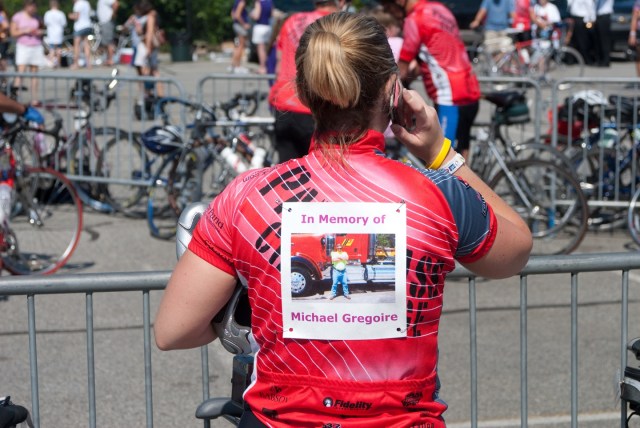
Rider at Saturday finish, Mass Maritime Academy

Rider at Saturday finish, Mass Maritime Academy

Seeing such things made a deep impression on me when I rode in the PMC. I can still remember quite clearly climbing the first big hill back in 1995, slowly passing a bagpiper playing Amazing Grace in the early morning haze. The poignancy of that moment brought a lump to my throat and tears to my eyes as I sensed the depth of feeling associated with the ride.

Although I had lost friends and co-workers to cancer over the years, I didn’t truly understand the power of the PMC until my father died from cancer.

I started out the ride that year apathetic and depressed, feeling very much alone even though there were over 2,000 riders around me. Over the early part of that ride I had an internal conversation in which I asked questions and just waited for answers to arise from where ever. I asked why suffering seemed so integral to life – why did people have to suffer from cancer like my father had, and why the pain of the bike ride was such an important part of the PMC. The answer I received was that suffering is the path to redemption – and rising to our best. I questioned why such suffering and redemption were necessary; the answer I got back was that we all need redemption, to get beyond whatever negativity and guilt we may feel about ourselves.

After 40 miles or so it began to rain, lightly at first. Around 80 miles into the ride I was part of a paceline that gradually lengthened as we went along. I started to notice flashes of lightning, the rumble of thunder and an increasing intensity of the rain. The storm became more severe, with occasional vivid lightning followed by loud crashes of thunder. With no reasonable place to stop, we rode on, the energy of the weather and the energy of the other riders increasing my energy to ride quickly and to get through the storm. Everything became a dimly lit, watery blur; I had no idea where we were, how far we’d gone or how far we had to go. We were just a stream of cyclists rushing down the flooded road, with the splashing wake of oncoming cars occasionally washing over our calves and feet.

Eventually the storm tapered off and the sky brightened. We soon came upon the 101-mile waterstop, and I realized we’d ridden right by the previous waterstop in the middle of the storm. After stopping briefly, I rode on to the finish, barely six hours after I’d started 111 miles away. It was the fastest I’d ever ridden the route from Sturbridge to Bourne.

That ride gave me a deeper sense of the power of the PMC. I had started out a lone rider, emotionally cut off from those around me. But riding with that group of riders through that storm had transformed my perspective. My alienation and bitterness had been washed away by the storm and the experience, and I happily joked with friends when I joined them at the finish line.

You might think, given the cause of the ride and the depth of feeling of the riders and those along the route, that the PMC has a somber, funereal quality to it. Nothing could be farther from the truth. What I learned in 2001 was that the PMC enables individuals who have been personally shaken by cancer to join together in a meaningful, powerful way to fight back. The collective power of thousands of riders raising millions of dollars for cancer research and treatment is tremendously uplifting. Aside from the pain of the actual riding, the PMC is really a quite festive affair.

Saturday Finish, members of Team L.E.G.S.

Saturday Finish, members of Team L.E.G.S. ("Legs Ending Great Suffering")

We’ve all been touched by cancer in one way or another; we’ve all experienced feelings of helplessness and despair when confronted with this dread disease. At the PMC, we all have our individual stories about cancer. But we come together in early August as one, sharing a common goal of fighting back and of eventually overcoming cancer. As the years have gone by – it was the 30th PMC last weekend – the riders share the growing confidence of the doctors from Dana-Farber who speak each year at the opening ceremonies on the night before the ride. The tide is turning, our collective knowledge and understanding of how cancer works is growing, and it’s only a matter of time before we – as a group – beat cancer.

Posted in dual nature | Tagged , , , | Leave a comment

Wave Riding

The Tour de France – the world’s greatest bike race – ended yesterday. The Pan-Mass Challenge – America’s greatest cycling fund raiser – takes place this coming weekend. In honor of those two major cycling events, I’m reviving an essay I wrote twelve years ago about cycling and the wave/particle duality. (Hey – blogs didn’t exist in 1997!)

Many people who are not avid cyclists – or French – have a hard time understanding bike racing. What they usually get from the mass media focuses on the individual accomplishments of riders like Lance Armstrong or Greg Lemond. A lot of people are surprised to learn that bike racing is really a team sport.

Especially in America, where we constantly hear arguments based on the idea that we must chose between either individualism or collectivism, the idea that the interests of both the individual and the group are intertwined seems alien and unfathomable.

In spite of any preconceptions we may harbor, the fact is that bike racing, and high performance cycling in general, revolve around this both/and dynamic of group and individual interests. For those of us avid riders and Tour followers, the interplay between these interests is part of what makes cycling so appealing.

What I’ve said so far is pretty abstract; my essay spells things out more clearly. The only thing I’d note is that it was written twelve years ago; I’m not quite so speedy on a bike these days…

***************************

During the summer, I spend a fair amount of time on a bicycle, riding over 3,000 miles per year. I find cycling offers a number of benefits, including better health, an enhanced sense of self, and the opportunity to explore the suburban and rural countryside in New York State’s Capital Region. It also gives me a lot of time to think. And sometimes, cycling gives me an insight that could be pertinent to living in the Quantum Age.

To introduce you to this particular insight, let me begin by telling you about my cycling experiences over the course of a week in July, 1997.

On Tuesday, I decide to squeeze in a quick solo ride after work. I ride from my house to the nearby state office and university campuses, each ringed with a lightly traveled access road. The route is generally flat and I’m able to ride at what feels like a fairly quick and constant speed. After a little over an hour of riding, I return home, having ridden at an average speed of 18.2 miles per hour for 19 miles.

On Thursday, I meet a group of friends for our weekly ride. On this sunny summer evening, I ride with the group up and down over the rolling countryside of southern Albany County. Although we’re often cruising at 20 to 28 miles per hour on the flat stretches, I’m feeling relaxed and enjoy some spectacular views southward to the dark green peaks of the Catskills, looming over bright green fields glowing in the late day sun. However, after an hour or so I begin to feel the effects of the hills we’ve been climbing, as well as an apprehension about a long, steady hill I know we’ll have to deal with near the end of the ride. Near the turn for this hill, I slow a bit to drink some water and consume a packet of energy gel. In doing so, I get slightly separated from the pack. This separation widens when I see the group go by the turn we’re supposed to take for the big hill. I slow a bit and yell to them that they’d missed the turn, but they continue down a steady grade. I try to speed up to catch them, but they fade gradually from view. I continue on my own, not as quickly as before, but fast enough to finish with an average speed of 18.3 miles per hour over 32 miles.

On Saturday, seven of us gather in the morning at a lake house in Bolton, on the west shore of Lake George in the Adirondacks. Our planned route is fairly straightforward: ride around Lake George. We start out shortly after 9 AM, heading south to Lake George Village. We ride easily as we warm up, focused on the steady flow of traffic passing on our left as it heads south to the village. But as we head east out of the village, we pick up our pace. When we stop in Whitehall to take a short break after riding 35 miles, our average speed is 21 mph. This average drops a bit on the rolling hills between Whitehall and Ticonderoga, and drops some more as we ride over Tongue Mountain on the way down the west side of the lake back to Bolton. Still, we average 18.4 mph for the entire 94 mile ride.

There are many things cyclists disagree about, from what is the best bike equipment to where the best places to ride are. However, pretty much every road cyclist will agree that it’s easier and faster riding in a group than riding by oneself. This is generally attributed to the aerodynamic benefits that come from cyclists taking turns drafting in the pack. But I think there is something else at work here as well.

As I’ve noted before, through quantum physics we know that everything can be seen as both a wave and a particle. However, we are accustomed to thinking of people from an individual, particle perspective. If we see a group of cyclists riding together, we tend to think that they are staying together through the individual effort of each rider, and that the only benefit they get from this grouping is aerodynamics. And from a particle perspective, we’re right.

But there is another, less tangible benefit at work here. Riders in a group will often feel a higher level of energy, as well as an inclination to “get in synch” with the others in the group. This can lead to a higher level of performance. The effect is like that of waves moving in the same direction: just as such waves amplify each other and create a larger wave, riders in a group can amplify each other’s performance.

But this doesn’t just apply to those riding within the aerodynamic “cocoon” of the group. Individual riders close to the group may feel this effect as well. If I suddenly see a group coming up behind me, I may feel a rise in my energy level, urging me to either stay ahead of them or (more likely) to prepare for the faster pace I’ll need to maintain to keep up with them when they catch me. If I’m close behind, I will push myself to speed up and join the group. In either case, my attention will tend to focus on the group, and my inclination will be to synchronize my pace with its own.

However, there appear to be several variables that can alter this effect.

One is the difference in speed between the individual and the group. If a group is going either too fast or too slow, I will not feel much inclined to join them and will feel little effect from our passing each other. I have to be going at close to the same speed as the group for me to feel the effect of their presence. Even if I do join the group, the effect will be more or less powerful depending on how closely I feel in synch to the group’s pace. If they’re going somewhat faster or slower than I’m inclined to go, I may gradually feel less attuned to the group’s energy and either break away or drop behind.

Another variable is the size of a group. All other things being equal, I will feel more energized from a group of 50 than I will from a group of 2 or 3. It is as if the larger the group, the more anonymous I become and the more I can lose myself in it. By giving a part of myself over to the group, my sense of my own aches, pains and limitations seems diminished, and I’m able to perform at a higher level.

One other variable is the distance between myself and the group. The farther behind or in front of me the group is, the less effect I’ll feel from it and the less inclined I’ll feel to join it. If the group is too far behind, I’ll be inclined to disregard it until it gets close enough to judge its speed and size. If I’m too far behind a group I’ve been dropped by, I will get a sense that it is out of reach and adjust my pace to a rate I can sustain by myself. However, if I catch a glimpse of a group ahead of me that I hadn’t seen before, I may quicken my pace a little to see if I can catch up to it.

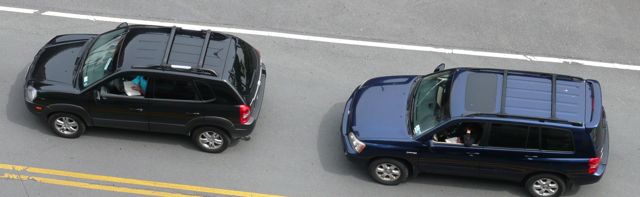
While I have been discussing this phenomena in terms of cycling, it can be seen in many other areas of life as well. I believe it is at work on the highway, where you can often see cars grouped together in packs while other stretches of highway are virtually empty. It could also apply to spectator sports, in which teams often seem to play much better “at home” then they do “on the road.” It might even explain why people tend to live together in villages or cities, and why the energy level and tension seems to be higher in areas with higher population densities.

Some of the problems we face today come from our thinking of people only from the individual/particle perspective, disregarding the importance of our simultaneous group/wave nature. Laws often appear to be written to prohibit individual behaviors, usually without due consideration of the social or group dynamics that might be encouraging such prohibited behaviors. Social programs often seem to focus on an individual’s needs for food and shelter,  without consideration of his or her needs for social interaction and involvement. And in the workplace managers frequently relate to workers as a collection of isolated individuals, disregarding the subculture of the work group that is usually the ultimate shaper of employees’ values and beliefs.

In the midst of all this, we tend to view our selves as solitary souls, overwhelmed and powerless against the monolithic corporations, bureaucracies and other obstacles that confront us. We describe ourselves as merely “cogs in the machine” or “pawns in the game of life.” And all too often we avoid confronting the stupidity or inhumanity we encounter, settling instead for an uneasy peace.

Maybe we need to broaden our perspective, and recognize the power that can come from our wave-nature as well. Life is a balance between the particle and the wave, between the individual and the group. And just as an expert cyclist recognizes that maximum performance comes from being able to ride both alone and in a group, maybe we need to transcend our one-dimensional Newtonian solitude and draw power from our quantum duality.

Posted in dual nature, energy/flow | Tagged , | 1 Comment

Uncertain Times

A recent op-ed in the New York Times has sparked discussion among bloggers and pundits about uncertainty. Apparently, according to Harvard psychologist Daniel Gilbert – in his piece “What You Don’t Know Makes You Nervous” – people don’t feel comfortable with uncertainty. He concludes:

Our national gloom is real enough, but it isn’t a matter of insufficient funds. It’s a matter of insufficient certainty. Americans have been perfectly happy with far less wealth than most of us have now, and we could quickly become those Americans again — if only we knew we had to.

Now I would think proclaiming that people are uncomfortable with uncertainty is stating the obvious – kind of like saying teenage boys think a lot about sex. Many of us have lives filled with routines that lend an element of predictability and certainty to our world. And we often assume roles that society has defined as appropriate. This reminds me of a dialogue in the movie My Dinner With Andre:

ANDRE: You know, that was one of the reasons that Grotowski gave up the theater. He just felt that people in their lives now were performing so well that performance in the theater was sort of superfluous, and in a way obscene.

WALLY: Hum!

ANDRE: I mean, isn’t it amazing how often a doctor will live up to our expectation of how a doctor should look? I mean, you see a terrorist on television: he looks just like a terrorist. I mean, we live in a world in which fathers, or single people, or artists, are all trying to live up to someone’s fantasy of how a father, or a single person, or an artist, should look and behave! They all act as if they know exactly how they ought to conduct themselves at every single moment. And they all seem totally self-confident. Of course, privately people are very mixed up about themselves.

In any case, a number of pundits and bloggers have picked up the discussion about uncertainty. Beyond the blogs that simply repeat Gilbert’s entire article or make some brief comment about it, there are those who use its mention of uncertainty to spin their own perspectives. Kathleen Parker used the column as a springboard for saying why conservatism is good and a social safety net is bad:

Certainty may be the promise of government, but uncertainty is the grease of free markets. Uncertainty was also America’s midwife. Without a tolerance for uncertainty — and unhappiness — our nation’s Founders might have remained in their rockers.

Hmmm…I guess that explains why the United States was such an unproductive place in which everyone “remained in their rockers” and nothing happened during the 40’s, 50’s and 60’s, when New Deal and Great Society programs were in their heyday.

Meanwhile, various letters to the editor of the Times reached a variety of other conclusions, including some diametrically opposed to Parker’s argument:

Mr. Gilbert’s observations help explain why, in studies of happiness and life satisfaction, the countries of northern Europe repeatedly top the list, well ahead of the United States. These countries thrive on capitalism underpinned by a safety net of socialist institutions that relieve their people of many of the uncertainties and anxieties that plague us here.

Apparently, even the significance of uncertainty is uncertain today.

I would suggest there are different kinds of uncertainty that can be at play in our lives. Some types of uncertainty are nearly universal, like a teenage boy getting up the courage to ask a girl out on a date. For him at that moment, it may feel like the most stressful thing in the world. But it’s really an experience that spans cultures and generations. The same could be said for people starting a business or seeking a job.

But there’s another kind of uncertainty that’s a product of something bigger: a revolutionary shift in our perception and understanding of how our world works. Such events are rare, but their effects can be devastating to the existing societies and cultures of their time. When Copernicus argued that the earth rotated around the sun rather than the other way around, it set in motion events that led to the rise of science and the demise of many irrational superstitions. The Industrial Revolution likewise shook to their foundations the cultures and societies with which it came in contact.

We are currently going through another of these epochal shifts, thanks to the scientific revolution that started in the 20th century and that led to the creation of the technologies that have reshaped our world today. That revolution created a great sense of uncertainty among scientists at the time, like Werner Heisenberg:

The violent reaction on the recent development of modern physics can only be understood when one realizes that here the foundations of physics have started moving; and that this motion has caused the feeling that the ground would be cut from science.

There are many times today when we may feel “the ground has been cut” from our familiar world. The uncertainties we experience in dealing with today’s new world can make us even more nervous than an economic downturn. After all, we can read histories about other recessions and even depressions and learn how people survived them. But nothing in human history can compare to the tightly interconnected world we find ourselves in today.

But in a way that’s not entirely true. As his statement illustrates, scientists like Heisenberg and Einstein were as unsettled by their discoveries as we are today by the world those discoveries have created. And yet eventually scientists moved beyond this discomfort. Perhaps if we follow their lead we can learn how to find new certainties in this uncertain world. In his book Quantum Soup; A Philosophical Entertainment, Chungliang Al Huang wrote about paradox –  a primary facet of our current uncertainty. His observation seems as relevant as ever today:

Perhaps we need to look at paradox in a new way — more naively and accepting — recognizing the reasonableness of accepting yes/no, at the same time finding a new logic in the illogical, a new consistency in the inconsistent, and embracing absurdity as making quite good, if different, sense.

Albert Einstein said he did not believe that “God plays dice with the universe,” and so he remained uncomfortable with the new quantum theory when it came along, a theory that abounds with chance, randomness, and paradox. Yet now we have a whole new generation of physicists who are quite at ease with paradox. In fact, they encourage us to take their hand, let go of old patterns and open the way to new worlds for ourselves and for our children. They ask us to leave behind the world of either/or for the world of both/and. Paradox is part and parcel of the new physics.

Paradox – and uncertainty – are also part and parcel of our world today. It’s time we stopped fretting about it and began dealing with it. I suspect even Daniel Gilbert would agree that would make us happier.

Posted in uncertainty | Tagged , | Leave a comment

“Stuff” Happens

If you’re looking for a clue as to why we have so many problems in today’s world, one place you might look is how we actually look at problems.

Our traditional way of dealing with a problem is to break it down into pieces, examine those pieces for flaws, fix whatever flaws we find, and then patch everything back together and congratulate ourselves on a job well done.

Basically, we approach problems in life the way we approach problems with our car. Unfortunately, while this approach may be successful in fixing our car, it’s much less likely to be successful in fixing our problems in life.

While this “break into pieces” approach may come naturally to us today, it’s actually a product of the traditional scientific method. As David S. Walonick, Ph.D. explains,

Since Descartes, the “scientific method” had progressed under two related assumptions. A system could be broken down into its individual components so that each component could be analyzed as an independent entity, and the components could be added in a linear fashion to describe the totality of the system.

Unfortunately, this approach often doesn’t work in complex systems like the economy, society or the environment. Over the course of the 20th Century, people started to realize that it’s impossible to break such systems down in any meaningful way. Instead, they realized you have to look at the system as a whole.

Over time, this realization led to the development of a new approach to dealing with problems in complex systems: systems thinking. To quote Wikipedia, systems thinking is:

…a framework that is based on the belief that the component parts of a system can best be understood in the context of relationships with each other and with other systems, rather than in isolation.

Because we’re in the habit of breaking things into pieces, understanding the basics of systems thinking can seem a little complicated. But sometimes someone creates a presentation describing a system in crisis that gives us a deeper understanding of the problems confronting us.

The New York Times recently ran an article about an increasingly popular video called “The Story of Stuff,” which explores the relationship between our consumer society and the earth’s environment.  As the Times notes, the video “shows students how their own behavior is linked to what is happening across the globe.”

I agree that it’s an excellent video that gives us a deeper understanding of our role in contributing to today’s environmental problems. But beyond that, it also serves as an excellent example of systems thinking.

Maybe, if we gain a better understanding of systems thinking, we’ll be able to respond to complex problems with more than just a hollow excuse that “Stuff happens.”

Posted in complexity, holism | Tagged , | Leave a comment

Fantasyland Comes to Town

Every once in a while the Albany area turns into “Hollywood on the Hudson,” as a film crew for this or that movie comes to town. Each time this happens, there is a curious kind of encounter between our usual, everyday reality and the Fantasyland reality that’s inherent in making a movie.

A few movies are filmed here because that’s where they’re set; the most famous of those is Ironweed.  Numerous others – like Seabiscuit, Scent of a Woman, The Horse Whisperer and the upcoming Taking Woodstock – are filmed in whole or part around here because of film-friendly settings.

Over the past two weeks we’ve had both the pleasure and the hassle of having another movie – Salt – film a chase scene on our main highway interchange in downtown Albany. Apparently, that interchange looks something like one in Washington D.C. And rather than inconvenience all the people in Washington, the movie’s deciders decided it would be better to inconvenience us. Heck, they probably figured we’d enjoy the inconvenience. At least there wouldn’t be any Ferraris involved.

"Salt" camera crew set to film action in a staged traffic jam

"Salt" camera crew set to film action in a staged traffic jam

Early on, they were right. When the movie crew arrived in town, everyone got excited. Those of us with office windows overlooking the highway could see cars and trucks lined up for a take in one spot or another on the interchange. Some local people walked to where they could get a glimpse of the activities – from a street, the pedestrian bridge, or maybe a parking garage. The Albany Times-Union even snapped a bunch of pictures of the activities, including a brief appearance in town of the movie’s big star, Angelina Jolie.

It was interesting to see how an event like this can change your perspective about something familiar. Before the news of this filming, those of us who live or work in the area generally looked at the interchange in question as something to get through between Point A and Point B. Sure, when looked at from above it had a certain flashiness about it – kind of like some highway engineers were showing off. But for the most part it was still just another part of the local highway system that could get choked with cars during rush hour.

A view of some of Albany's soon-to-be-famous ramps

A view of some of Albany's soon-to-be-famous ramps

But the day the shooting started, everyday things assumed a new possibility: a connection with The Movie. As I drove down the highway that morning, I saw a crane truck in another lane. I wondered if it was somehow involved with the movie. (It was.) When I got off at my exit, I noticed that the boat house parking lot under the highway overpass – normally unremarkable and filled with commuters’ cars – was filled with trucks and bustling with activity. Later, after the police and road crews closed various ramps, we were treated to the sights of cars and trucks occasionally driving forward for a take, then carefully backing up to prepare for another.

There’s an interesting juxtaposition of “realities” when an everyday location is used in a movie. On the one hand, there’s a change in how that location is viewed by those of us familiar with it. For us the interchange was no longer just a highway; it had become a movie set! It had assumed a little bit of Hollywood glamor and would soon be famous – associated around the world with a gripping chase scene in the movie Salt.

Then there’s the fact that when we watch the movie – and I suspect there’ll be a lot of local people checking it out, if only for that chase scene – we’ll be watching it in a way different from those unfamiliar with the interchange. The general public will be watching the action and wondering what happens next. If the movie is done right, people may even believe it’s happening just as they see it.

But for those of us familiar with the location, we will be at least subconsciously trying to figure out exactly where each cut in the scene was made. (When I saw the movie Ironweed, which supposedly took place in Albany, I found it a bit distracting to recognize scenes that were supposed to be Albany but which were actually Troy, Slingerlands, Hudson and elsewhere.)

Beyond that, we have been privy to a fact that’s clear to anyone associated with filming a movie: it’s all made up. While most moviegoers can lose themselves in the sights, sounds and plot of a good movie, we’ll know that chase scene is totally fiction. After all, we saw cuts made on ramps headed south here, and north there. We know that one shot will take place in the middle of the interchange, while the next shot might take place on an access road half a mile away that runs in the opposite direction. Those who have seen even part of a movie filmed will have a very different sense of its “reality” than those who haven’t.

Finally, there is another reality that those of us who watch a movie being made quickly discover. At its most basic level, filming a movie involves a lot of boring times just sitting around, waiting for the Powers That Be to set up the next shot. The scene that took two weeks to be filmed in Albany will probably take less than five minutes in the actual movie. In Fantasyland, time really is relative.

That's not the script...bored drivers find time to read between shots

That's not the script...bored drivers find time to read between shots

Eventually, the mystique of watching movie fantasies being made tends to wear off. There are the hassles of trying to get to or from work when major commuter ramps are closed for movie-making. There’s the “been there, done that” feeling that arrives as we see yet another day of cars parked in long lines and only occasionally moving forward or back. And there’s the annoyance of trying to get work done when many car horns start blaring below your window for a take in the simulated traffic jam. While we had been excited to see the movie crew arrive, we also weren’t that sorry to see them go.

On the border of Fantasyland - momentarily filled with cars in a fake traffic jam

On the border of Fantasyland - momentarily filled with cars in a fake traffic jam

In the end, our brush with Hollywood and its fantasy creators was an entertaining break from daily routine. And I think many of us will be looking forward to seeing the results of this creation up on the big screen…or perhaps (eventually) a not quite so big TV screen. We may also retain an alternate, more glamorous view of the highways that have been so much a part of our daily routine.

And at least one of us (that would be me) has been able to find yet another example of how reality can be relative, dependant on your own perspective and experiences. You never know what can happen when Fantasyland comes to town…

Posted in relativity | Tagged , | Leave a comment

Flu In The Time Of Globalism

The big news item of the moment is the growing threat of a swine flu pandemic. The speed with which this disease has spread is yet another reflection of our interconnected world. In earlier times diseases tended to travel slowly from place to place, often with localized events; the Third Pandemic started in China in 1855 and slowly traveled around the world until the 1950s. With the availability of cheap air travel, things can happen much faster today.

The primary question is what do we do about this risk? The New York Times columnist David Brooks observes:

In these post-cold war days, we don’t face a single concentrated threat. We face a series of decentralized, transnational threats: jihadi terrorism, a global financial crisis, global warming, energy scarcity, nuclear proliferation and, as we’re reminded today, possible health pandemics like swine flu.

He goes on to present two possible approaches:

So how do we deal with these situations? Do we build centralized global institutions that are strong enough to respond to transnational threats? Or do we rely on diverse and decentralized communities and nation-states?

After providing a brief discussion of both options, he comes down in favor of the decentralized, bottom-up approach:

A single global response would produce a uniform approach. A decentralized response fosters experimentation.

The bottom line is that the swine flu crisis is two emergent problems piled on top of one another. At bottom, there is the dynamic network of the outbreak. It is fueled by complex feedback loops consisting of the virus itself, human mobility to spread it and environmental factors to make it potent. On top, there is the psychology of fear caused by the disease. It emerges from rumors, news reports, Tweets and expert warnings.

The correct response to these dynamic, decentralized, emergent problems is to create dynamic, decentralized, emergent authorities: chains of local officials, state agencies, national governments and international bodies that are as flexible as the problem itself.

I’ve written about emergent phenomena before, and I’m generally in favor of approaches that promote it. But it’s important to realize that the outcome of a bottom-up approach is tied to a larger context. Without proper guidance and values, free-wheeling emergence can lead to anarchy.

There’s an excellent article – Command and (Out of) Control: The Military Implications of Complexity Theory – that offers an interesting take on Brooks’ dichotomy. The author John Schmitt starts with a discussion of traditional command and control theory, which he says is based on a mechanical world view inherent in classic Newtonian physics. This approach relies heavily on a top-down approach, with those on top striving to control both their organization and whatever larger situation they’re confronting. The “centralized global institutions that are strong enough to respond to transnational threats” that Brooks talks about reflect this traditional kind of command and control.

However, like Brooks, Schmitt has problems with this approach. He starts by describing traditional command and control:

The natural result is a highly proceduralized or methodical approach to the conduct of military operations—war as an assembly line. Newtonian command and control tends to be highly doctrinaire—heavy on mechanistic and elaborate procedures. The mechanistic view recognizes that war may appear disorderly and confusing but is convinced that with sufficient command and control we can impose order, precision, and certainty. We can eliminate unpleasant surprises and make war go “like clockwork.” Just as the Scientific Revolution sought to tame nature, the Newtonian approach to command and control—especially with the help of the information-technology revolution—seeks to tame the nature of war.

But there’s a problem, as Schmitt notes:

The Newtonian paradigm offers a neat, clean and intellectually satisfying description of the world—and of war. There is only one problem: it does not match most of reality.

Schmitt goes on to describe war – and the world – as an open, dynamic, complex system. As such, it is impossible to control in a traditional, top-down way:

One of the defining features of complex systems is a property known as emergence in which the global behavior of the system is qualitatively different from the behavior of the parts. No amount of knowledge of the behavior of the parts would allow one to predict the behavior of the whole. Emergence can be thought of as a form of control: it allows distributed agents to group together into a meaningful higher-order system. In complex systems, structure and control thus “grow” up from the bottom; they are not imposed from the top. Reductionism simply will not work with complex systems: the very act of decomposing the system—of isolating even one component—changes the dynamics of the system. It is no longer the same system.

All of this is pretty much in line with what Brooks said in his column. However, in viewing our options as either “centralized control” or “decentralized control,” Brooks misses another alternative.  Schmitt presents an approach that encompasses input from those at the top and those at the bottom:

Rather than thinking of “command” and “control” both operating from the top of the organization toward the bottom, we should think of command and control as an adaptive process in which “command” is top-down guidance and “control” is bottom-up feedback…All parts of the organization contribute action and feedback—”command” and “control”—in overall cooperation. Command and control is thus fundamentally an activity of reciprocal influence involving give and take among all parts, from top to bottom and side to side.

From this perspective, we might agree with Brooks’ argument to “create dynamic, decentralized, emergent authorities: chains of local officials, state agencies, national governments and international bodies that are as flexible as the problem itself.” However, we should also have in place institutions – like perhaps the World Health Organization in the case of a pandemic – that can serve as resources for relevant information and avenues for collaboration among those decentralized authorities.

Such an arrangement assures that all involved are seeing the whole picture – both the forest and the trees.

Posted in complexity, emergent, interconnected | Tagged , , | 1 Comment